
Revision Spine Surgery in Noida - Expert Care When Your First Surgery Didn't Work
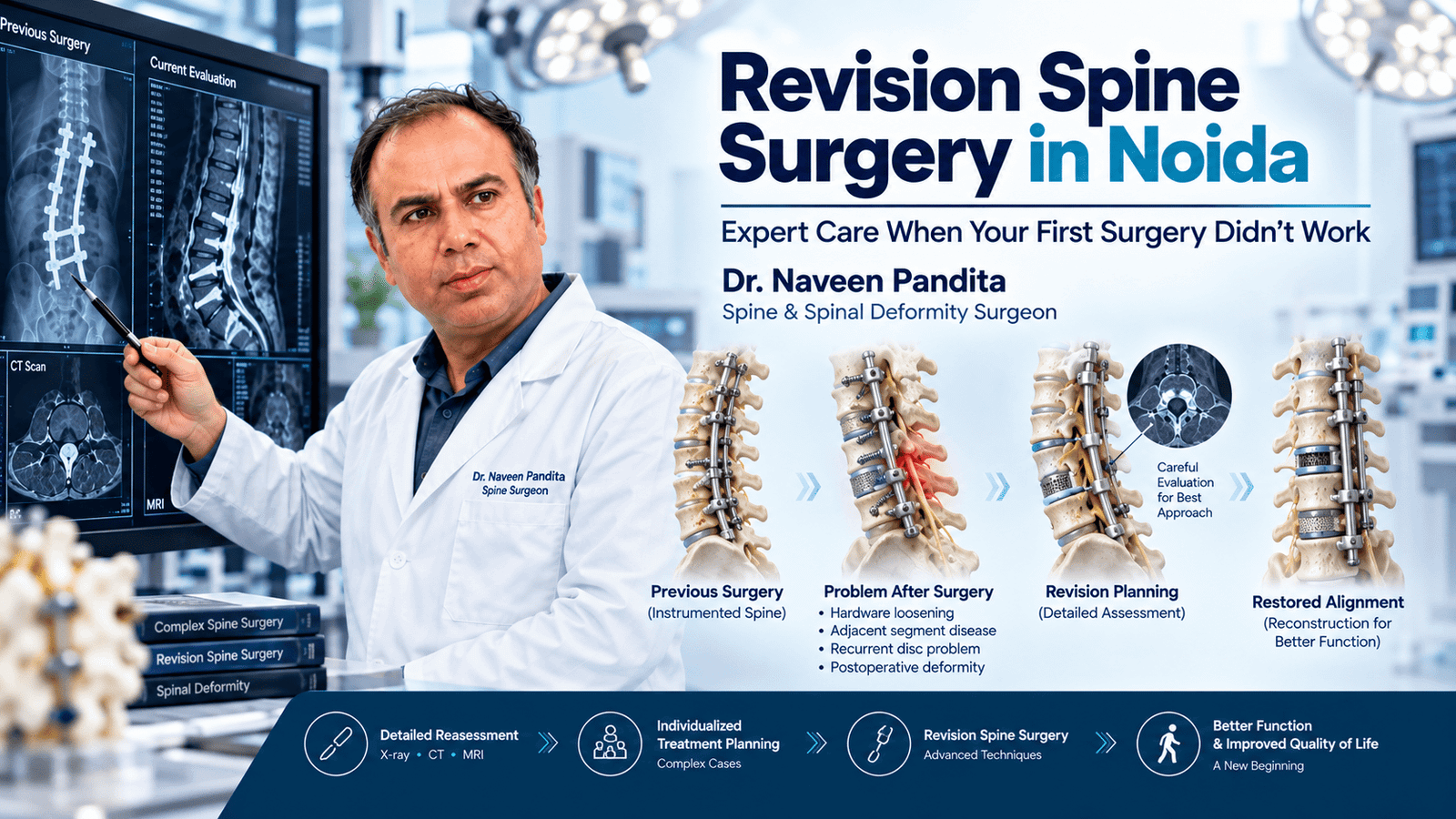
Revision spine surgery is a second operation performed to correct a spine problem that persists, returns, or develops after a previous spine surgery. Dr Naveen Pandita, a fellowship-trained spine and spinal deformity surgeon at Max Hospital, Noida & Vaishali, specialises in revision cases, including previously instrumented spines, failed fusions, and complications from earlier surgery, that many general spine surgeons choose not to take on.
If you had spine surgery and you’re still in pain, or your symptoms have returned or worsened, you are not out of options. Revision surgery is technically more demanding than a first operation, which is exactly why it should be evaluated by a surgeon with specific experience in difficult, previously operated anatomy.
What Is Revision Spine Surgery?
Revision spine surgery refers to any operation performed on a part of the spine that has already been surgically treated. It isn’t a single procedure; it can mean removing and replacing failed hardware, re-doing an incomplete decompression, extending a fusion that’s now causing problems at the level above or below it, or addressing infection or scar tissue from the first surgery.
It differs from a first-time (“primary”) spine surgery in one crucial way: the anatomy is no longer normal. Scar tissue, existing implants, and altered bone structure make every step, from reading imaging to identifying nerves safely, harder and higher-risk. This is why revision surgery is best entrusted to a surgeon who performs it regularly, not as an occasional case.
Why Do First Spine Surgeries Fail?
Many patients quietly assume nothing more can be done, or blame themselves for a “surgery that didn’t work.” In reality, failure almost always has an identifiable, treatable cause:
- Incomplete decompression: nerve pressure was not fully relieved the first time.
- Pseudarthrosis (failed fusion) occurs when the bones fail to fuse solidly, resulting in persistent instability.
- Adjacent segment illness occurs when the spinal level near a previous fusion fails due to increased mechanical load.
- Implant failure or malposition refers to screws, rods, or cages that have become loosened, misplaced, or were incorrectly inserted.
- Recurrent disk herniation occurs when the disc material herniates again at the same level of operation.
- Infection is a post-surgical infection that causes long-term pain and, in some cases, implant loosening.
- Wrong-level or incomplete initial diagnosis: the surgery treated the correct level but not the underlying cause of suffering, or vise versa.
Identifying which of these applies to your case is the first, most important step, and it’s usually possible to pinpoint even years after the original operation, with the right imaging and examination.
Signs Your Previous Spine Surgery Didn't Work
You may be a candidate for a revision evaluation if any of the following apply:
- Pain improved briefly after surgery, then returned
- Pain never actually improved after the operation at all
- New numbness, weakness, or radiating pain has developed since surgery
- You’ve been told your fusion “hasn’t taken,” or that hardware has loosened
- You’re experiencing new pain at the level next to where you were previously operated
- You’ve developed a limp, balance problems, or reduced walking distance since surgery
- A previous surgeon told you “nothing more can be done”
Dr Naveen Pandita hears that last point often from revision patients, and it’s often inaccurate. A fresh evaluation with current imaging can reveal treatable causes that weren’t addressed the first time around.
How Dr Naveen Pandita Evaluates a Failed Spine Surgery
Every revision evaluation begins with understanding exactly what was done in the first surgery and why it hasn’t worked:
- Review of previous surgical records and implants: operative notes, hardware type, and the levels operated on
- Fresh imaging: updated MRI and CT scans to assess fusion status, hardware position, and nerve compression, because old scans rarely reflect the current picture
- Clinical examination: correlating your present-day symptoms with what the imaging actually shows, rather than assuming the original diagnosis was correct
- Ruling out non-spinal causes: chronic post-surgical pain isn’t always structural, and this is assessed before any further surgery is recommended.
- An honest discussion of whether revision surgery is the right next step; not every failed surgery needs another operation. Dr Naveen Pandita recommends revision only when there is a clear, correctable cause.
Revision Spine Surgery Techniques
Because revision cases involve previously altered anatomy, Dr Naveen Pandit, a complex spine and spinal deformity surgeon, uses techniques specifically suited to difficult, previously operated spines:
- Removal and revision of loosened, malpositioned, or failed hardware
- Extension of fusion to address adjacent segment breakdown
- Navigated surgery for precision in distorted anatomy and altered landmarks
- Intraoperative neuromonitoring (MEP/SSEP) to reduce nerve risk in scarred, previously operated tissue
- Anterior and lateral approaches (ALIF/OLIF) as an alternative route when the back of the spine is heavily scarred from earlier surgery
- Management of pseudarthrosis with bone grafting and updated fixation
What Results Can You Realistically Expect?
This is worth addressing directly rather than through promotion: revision surgery can significantly reduce pain and improve function, but the results are typically less dramatic, and recovery is slower than after a first surgery, because scar tissue and altered anatomy limit how completely the original problem can be undone. During your consultation, Dr Naveen Pandita, known as the best spine surgeon in Noida, will provide you with a particular, honest assessment of what is realistically feasible in your circumstances, rather than a general promise.
Revision Spine Surgery Cost in Noida & Delhi NCR
Revision surgery generally costs more than a comparable first-time procedure, mainly due to longer operating time, additional imaging or navigation, and often more extensive implants. The ranges below are approximate; always confirm exact pricing after your consultation and imaging review, since cost depends heavily on case complexity.
|
Type of Revision Procedure |
Approximate Cost Range (INR)* |
Key Cost Factors |
|
Hardware removal/revision only |
₹1,80,000 – ₹3,00,000 |
Implant type, single vs multi-level |
|
Revision decompression (no fusion) |
₹2,00,000 – ₹3,50,000 |
Levels involved, scar tissue extent |
|
Revision fusion (pseudarthrosis repair) |
₹3,50,000 – ₹6,00,000 |
Bone grafting, navigation, implant type |
|
Adjacent segment fusion extension |
₹3,50,000 – ₹6,50,000 |
Number of additional levels |
|
Anterior/lateral revision (ALIF/OLIF) |
₹4,50,000 – ₹7,50,000 |
Approach complexity, reconstruction extent |
|
Complex multi-level revision |
₹6,00,000 – ₹10,00,000+ |
Case-specific; discussed individually |
Indicative only; varies by hospital (Max Vaishali vs Max Noida), room category, implant brand, anaesthesia, and length of stay. Cashless insurance and EMI options are available; discuss with the hospital’s insurance desk during consultation.
Schedule a consultation for revision spine surgery in Noida
Getting a Second Opinion for Failed Spine Surgery
If you’re considering a second opinion, it helps to bring:
- All previous MRI/CT scans (before and after your first surgery, if available)
- Operative notes/discharge summary from your first surgery
- Details of any implants used (implant card, if provided)
- A clear timeline of when symptoms improved, returned, or worsened
Dr Naveen Pandita reviews second-opinion cases at Max Multi Speciality Centre, Noida, and Max Super Speciality Hospital, Vaishali.
Frequently Asked Questions
Is revision spine surgery more risky than the first surgery?
Yes, generally. Scar tissue and altered anatomy from the first surgery make revision surgery technically more demanding, which is why it should be performed by a surgeon experienced specifically in revision cases.
My previous surgeon said nothing more can be done. Should I get a second opinion?
Yes. This is one of the most common reasons patients come to Dr Naveen Pandita for revision evaluation, and a fresh assessment with current imaging often identifies a treatable cause that wasn't addressed initially.
How soon after my first surgery can I have revision surgery?
It depends on the cause of failure. Some problems, like infection or hardware failure, may need earlier intervention; others, like adjacent segment disease, typically develop years later. This is assessed case by case.
Will I need a longer hospital stay for revision surgery?
Usually slightly longer than a first-time surgery, due to the complexity of working around scar tissue and existing implants. Exact duration depends on the procedure.
Does insurance cover revision spine surgery?
Most health insurance policies cover medically necessary revision surgery, similar to the first surgery. Cashless treatment is available at Max Hospital, Noida & Vaishali; confirm coverage specifics with your insurer during consultation.
What to do if spine surgery fails?
Start with fresh imaging and a clinical evaluation from a surgeon experienced in revision cases, rather than assuming the original diagnosis or treatment plan still applies. Many "failed surgery" cases have a specific, correctable cause once re-evaluated.
Can a failed spine fusion be corrected?
Often, yes. Pseudarthrosis (a fusion that hasn't solidly healed) can frequently be addressed with revision surgery using bone grafting and updated fixation, though the approach depends on why the original fusion didn't take.
Is a second spine surgery safe?
It carries higher technical complexity than a first surgery, but with careful evaluation, navigated techniques, and neuromonitoring, revision surgery is performed safely and routinely by surgeons with specific revision experience.
This page provides general information about revision spine surgery and is not a substitute for individual medical advice. Every case is different; book a consultation with Dr Naveen Pandita for an evaluation specific to your imaging and symptoms.
Schedule a consultation with Dr Naveen Pandita to discuss your case and treatment options