
Orthopedic Spine Surgeon in Noida: Dr Naveen Pandita Explains When Spine Surgery Is Really Needed
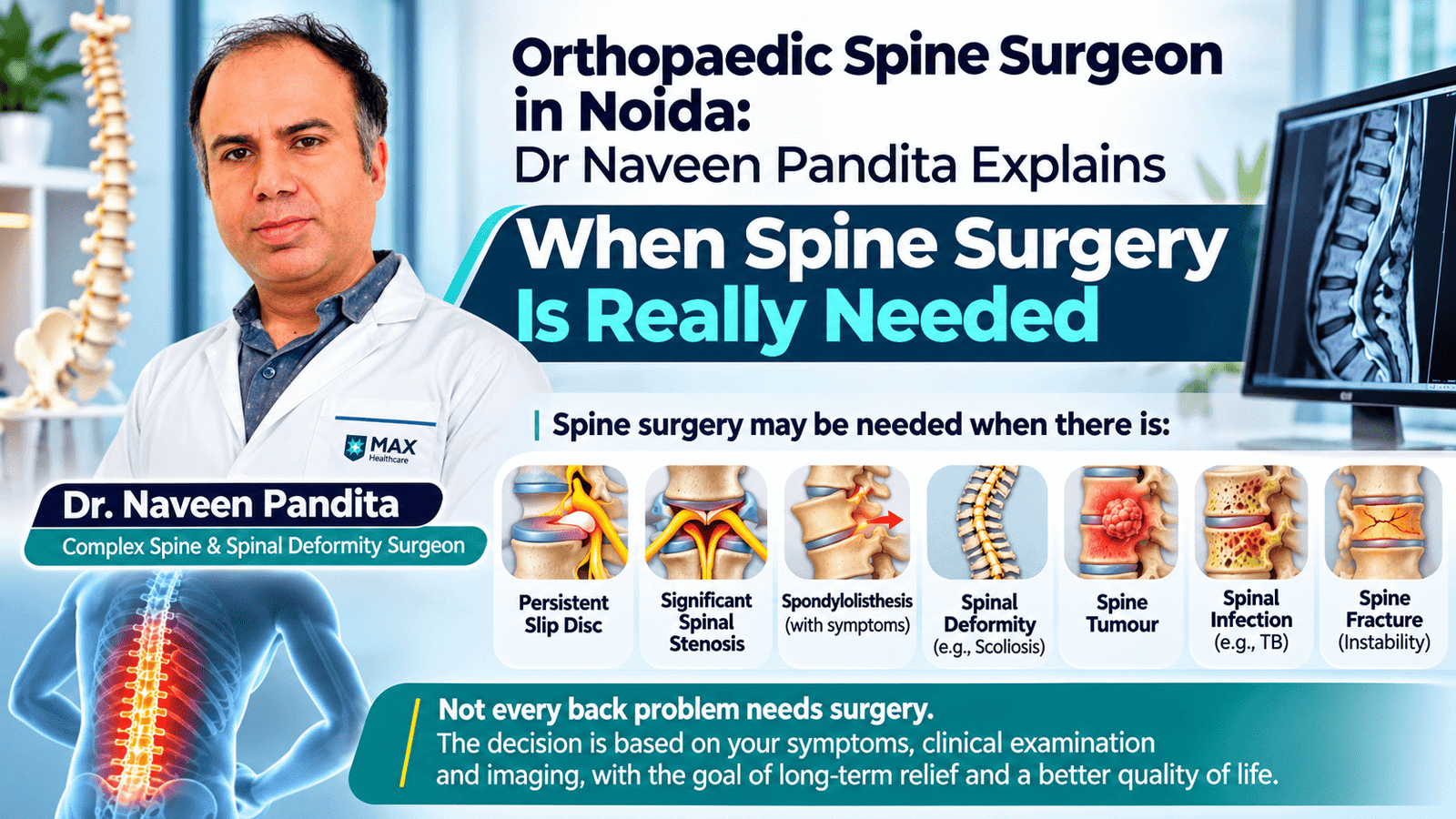
A persistent backache or a stiff neck that lasts for weeks can be debilitating. It has an impact on sleep, job performance, and mood. When patients finally step into my consultation room, many of them share the same concern: has it come to the point of surgery?
Most people say no. Surgery becomes a viable option only when a nerve or the spinal cord is under threat, when a clearly visible spinal condition explains your symptoms, or when well-planned non-surgical care has failed to provide you with a functional life. Certain symptoms, such as losing bladder or bowel control, must be treated immediately.
I am Dr Naveen Pandita, a fellowship-trained surgeon in complex spine and spinal deformity. As an orthopedic spine surgeon in Noida, I see patients from Noida, Greater Noida, Ghaziabad, Delhi, and the rest of the NCR, with problems ranging from slipped discs and narrowed spinal canals to scoliosis and complex reconstruction. In this article, I will walk you through the way I decide whether an operation is truly needed.
When Is Spine Surgery Really Necessary?
I ask myself three questions before suggesting an operation.
- Is something dangerous happening to the nerves? If a nerve root or the spinal cord is being squeezed hard enough to weaken muscles, cause a dull sensation, or disturb balance, and the trend is downward, surgery moves up the list.
- Does the scan explain the patient? A structural fault, such as a large disc fragment, a tight canal, or a vertebra that has slipped out of place, must match what the patient feels and what I find on examination.
- Has sensible treatment been given a fair chance? If pain or disability still rules your life after properly supervised non-surgical care, an operation can be discussed.
An MRI that mentions “disc bulge” or “wear and tear” is not an instruction to operate. Such findings are common in people with no pain at all. What counts is the person in front of me, not just the picture.
7 Warning Signs That You May Need Spine Surgery
The signs below mean you should see a spine specialist. They do not mean surgery is certain.
1. Muscle weakness that keeps getting worse
Tripping because the foot will not lift, dropping objects, or a leg that buckles all point to a nerve that is struggling. Weakness that is progressing needs early review.
2. Pain that persists even after proper non-surgical treatment
When disabling pain persists despite physiotherapy, appropriate medications, and adjustments in daily routines, and the scan reveals a compatible cause, surgery becomes a viable option. The length of time to wait varies according to the condition and individual.
3. Severe lumbar spinal stenosis
The area inside the lower spine becomes too cramped for the nerves. Patients frequently express leg pain, numbness, or heaviness after walking a short distance, which is eased by sitting or leaning forward. If your walking range is decreasing, a decompression procedure may be beneficial.
4. Pressure on the spinal cord in the neck (cervical myelopathy)
Confusion with buttons, messy handwriting, shaky driving, or feeling unsteady in the dark can indicate that the neck portion of the spinal cord is compressed. Unlike ordinary neck pain, it can get worse and lead to permanent damage, so don’t defer to a consultant’s opinion.
5. A prolapsed disc pressing hard on a nerve
A slipped disc may cause shooting pain down the leg (sciatica) or arm. Most settle without an operation. I consider surgery when there is real weakness, pain that cannot be controlled, or a large disc fragment clearly pinning the nerve.
6. A slipping or unstable vertebra
In spondylolisthesis, one vertebra shifts ahead of the next. Minor slips are typically treated without surgery. Larger slips, obvious instability, or nerve compression may necessitate decompression, sometimes in conjunction with fusion.
7. Spinal deformity that needs correction
Scoliosis, kyphosis, and other curvatures may need surgery if they are increasing, pressing on nerves, or interfering with how the body functions.
Please remember: these are reasons to be examined, not a diagnosis of “needs surgery.”
When Can Spine Problems Be Treated Without Surgery?
Most spine complaints improve without an operation. A typical programme may combine:
- Physiotherapy to restore movement and strengthen the muscles that support your spine.
- Medicines for pain or nerve irritation, taken under medical supervision and usually for a short period.
- Adjusting activity, avoiding what provokes pain while staying gently active instead of resting in bed.
- Lifestyle changes, such as better desk ergonomics, daily walking, and giving up tobacco, which harms discs and bone.
- Weight control, since every extra kilo adds load to the lower spine.
- Image-guided injections for selected patients, to quieten an irritated nerve and sometimes to confirm the source of pain.
No two spines are alike. What works for a young office worker with a disc problem may be unsuitable for an older person with a tight spinal canal. That is why I plan treatment for the individual.
When Should You Consult an Orthopedic Spine Surgeon in Noida?
Book a consultation if you notice:
- Back pain or neck pain that has lasted more than a few weeks without clear improvement.
- Pain, tingling or numbness travelling into an arm or leg.
- A shorter and shorter walking distance because of leg symptoms.
- Weak limbs or clumsy fine hand movements.
- Night pain that disturbs sleep, or pain that restricts work and routine.
- A spinal curve that is visible or increasing.
Go to an emergency department straight away if you have:
- Difficulty holding or passing urine or stool.
- Numbness in the groin, genitals or inner thighs.
- Sudden or quickly worsening weakness in both legs.
- Severe back pain following a fall or accident.
- Severe back pain together with fever, unexplained weight loss, or a history of cancer.
These may point to cauda equina syndrome, a fracture, or an infection, and delay can lead to permanent harm. Do not wait for a routine appointment.
What Tests Are Required Before Spine Surgery?
Diagnosis begins with a conversation and a physical examination, not a scan.
- Clinical and neurological examination: I test strength, sensation, reflexes, walking, and spinal movement. This is the single most useful step.
- X-rays: these show alignment, bone changes and whether vertebrae move abnormally.
- MRI: the main investigation for discs, nerves and the spinal cord.
- CT scan: used in selected cases for fine bone detail, for example in fractures, deformity or operative planning.
- Further tests when needed: nerve conduction studies, blood tests or bone density testing.
The rule I follow is correlation. A report must agree with your symptoms and examination. Operating on a scan instead of a patient is one of the most common routes to unnecessary surgery.
What Are the Modern Spine Surgery Options?
The choice of operation rests on your diagnosis, your anatomy, your symptoms, and your general health.
- Minimally invasive spine surgery: specialised instruments are used through small cuts to limit muscle injury. It is right for selected problems only.
- Endoscopic spine surgery: a slim camera and instruments pass through a tiny opening, mainly for chosen cases of disc prolapse and stenosis.
- Microdiscectomy: a microscope helps remove the piece of disc that presses on a nerve.
- Decompression surgery: bone or tissue is removed to free nerves, as in laminectomy or laminotomy for spinal stenosis.
- Spinal fusion: two or more vertebrae are joined to steady the spine in instability, significant slips,s or some deformities.
- Cervical spine surgery: includes anterior cervical discectomy and fusion, artificial disc replacement in selected patients, and posterior decompression for cord compression.
- Scoliosis and spinal deformity correction: reconstructive surgery to straighten and stabilise a curved spine.
“Minimally invasive” does not automatically mean “better.” The right operation is whichever one safely solves your particular problem. Every surgery has risks, including infection, bleeding, nerve injury, and incomplete relief, and these must be discussed frankly before you agree.
How to Choose the Best Orthopedic Spine Surgeon in Noida
Online, people often type “best spine surgeon in Noida” or “best spine doctor in Noida.” Instead of trusting rankings or advertising, I would suggest checking for these qualities:
- Dedicated spine training, not general practice alone.
- Real experience with your condition, whether that is stenosis, disc prolapse, cervical myelopathy, or deformity.
- Comfort with several techniques, so the method is fitted to you.
- Honest discussion of all choices, including non-surgical care and watchful waiting.
- Open talk about benefits, risks, and recovery, with no guarantees.
- Advice that is tailored, based on your examination and reports.
Dr Naveen Pandita is a fellowship-trained complex spine and spinal deformity surgeon in Noida. His areas of work include minimally invasive and endoscopic spine surgery, cervical and lumbar spine surgery, spinal stenosis, disc prolapse, spondylolisthesis, scoliosis, and complex spinal reconstruction. Before any major spine operation, seeking a second opinion is perfectly reasonable, and a good surgeon will welcome it.
Consult Dr Naveen Pandita at Noida Sports Injury Centre Clinic
If you want a spine specialist near you in Noida, Dr Naveen Pandita consults at Noida Sports Injury Centre Clinic, Block D, D-74, Sector 26, Noida, Uttar Pradesh 201303, from 5:00 PM to 7:30 PM.
The clinic is a practical choice for people living in neighbouring areas such as Sectors 12, 15, 18, 19, 20, 22, 25, 27, 28, 29, 30, 34 and 37. Patients also come from Sectors 40 to 56, Sectors 61 to 63, Sectors 75, 76, 78, 100 and 104, and from Greater Noida, Indirapuram, Ghaziabad and across Delhi NCR.
He also consults at these locations:
- Max Super Speciality Hospital, Vaishali: OPD Room No. 173, Department of Spine Surgery and Spinal Deformity, Vaishali, Ghaziabad, Uttar Pradesh 201019. Monday to Saturday, 9:00 AM to 5:00 PM; Sunday, 10:00 AM to 12:00 PM.
- Noida Sports Injury Centre Clinic, Sector 26, Noida
- Pushpanjali Medical Centre: A-14/15, Vikas Marg, Karkardooma, Anand Vihar, New Delhi, Delhi 110092. Tuesday and Friday, 5:00 PM onwards.
To arrange a spine consultation in Noida, call +91-8595680337 or write on WhatsApp. Please carry your earlier MRI, X-ray, and other reports.
Frequently Asked Questions
How do I know if my back pain requires surgery?
Most back pain never needs an operation. Surgery is considered when weakness is growing, bladder or bowel control is lost, an MRI shows severe nerve compression that fits your symptoms, or disabling pain remains after proper non-surgical care. Only an examination by a specialist can settle this.
Who is the right specialist for spine surgery in Noida?
Look for an orthopaedic spine surgeon, or a neurosurgeon with spine training. Choose someone who has focused spine experience, treats your kind of condition regularly, and explains non-surgical options as clearly as surgical ones.
Can a slipped disc heal without surgery?
Frequently, yes. Many prolapsed discs become less painful over weeks to months with physiotherapy, medicines, and sensible activity. Surgery is usually kept for marked weakness, severe pain that does not ease, or emergency symptoms.
How long should I try conservative treatment before considering surgery?
There is no one fixed period. When there is no weakness, a trial of several weeks to a few months is often reasonable. If weakness is increasing, the spinal cord is compressed, or emergency symptoms appear, waiting is unsafe.
Is minimally invasive spine surgery better than traditional surgery?
Not in every case. Smaller incisions and less muscle disturbance are real advantages, but only certain conditions suit this approach. The best method depends on your diagnosis and anatomy.
Is spine surgery safe?
When the reason for surgery is sound, and the surgeon is experienced, spine surgery is generally safe and is performed routinely. Risks still exist, such as infection, bleeding, nerve injury, or symptoms that do not fully go away, and your surgeon should explain them for your own situation.
Can spinal stenosis be treated without surgery?
Mild to moderate stenosis can often be handled with exercise, physiotherapy, medicines and, in some patients, image-guided injections. Surgery comes into view when walking is badly restricted, symptoms are getting worse,e or nerve weakness appears.
When does cervical disc prolapse require surgery?
Mostly when the disc presses on the spinal cord, when arm weakness is progressing, or when severe arm pain does not respond to non-surgical treatment.
How long does recovery after spine surgery take?
It varies with the operation. After endoscopic surgery or microdiscectomy, many patients walk within a day and return to light activity in a few weeks. Fusion and deformity surgery usually need several months. Your surgeon can estimate more precisely for your procedure.
Where can I consult Dr Naveen Pandita in Noida?
At Noida Sports Injury Centre Clinic, Block D, D-74, Sector 26, Noida, from 5:00 PM to 7:30 PM. He also consults at Max Multi Speciality Centre, A-364, A Block, Pocket A, Sector 19, Noida. Call +91-8595680337 to book.
Conclusion
Spine surgery is the right step when nerves or the spinal cord are in danger, when a clear structural fault explains your symptoms, or when careful non-surgical treatment has not given you back a normal life. For many people, physiotherapy, medicines, lifestyle changes and selected injections are enough. The purpose of seeing an orthopedic spine surgeon in Noida is not to be talked into an operation. It is to understand what is wrong and to choose the safest, most suitable treatment, which may be no surgery at all.
If you have ongoing back pain or neck pain, arm or leg symptoms, or any warning sign described above, please do not ignore it. To book an appointment with Dr Naveen Pandita, Principal Consultant – Spine Surgery & Spinal Deformity, visit Noida Sports Injury Centre Clinic, Block D, D-74, Sector 26, Noida (5:00 PM to 7:30 PM), call +91-8595680337, or message on WhatsApp.