
Spinal Deformity Treatment in Noida: Types, Diagnosis and Treatment Options
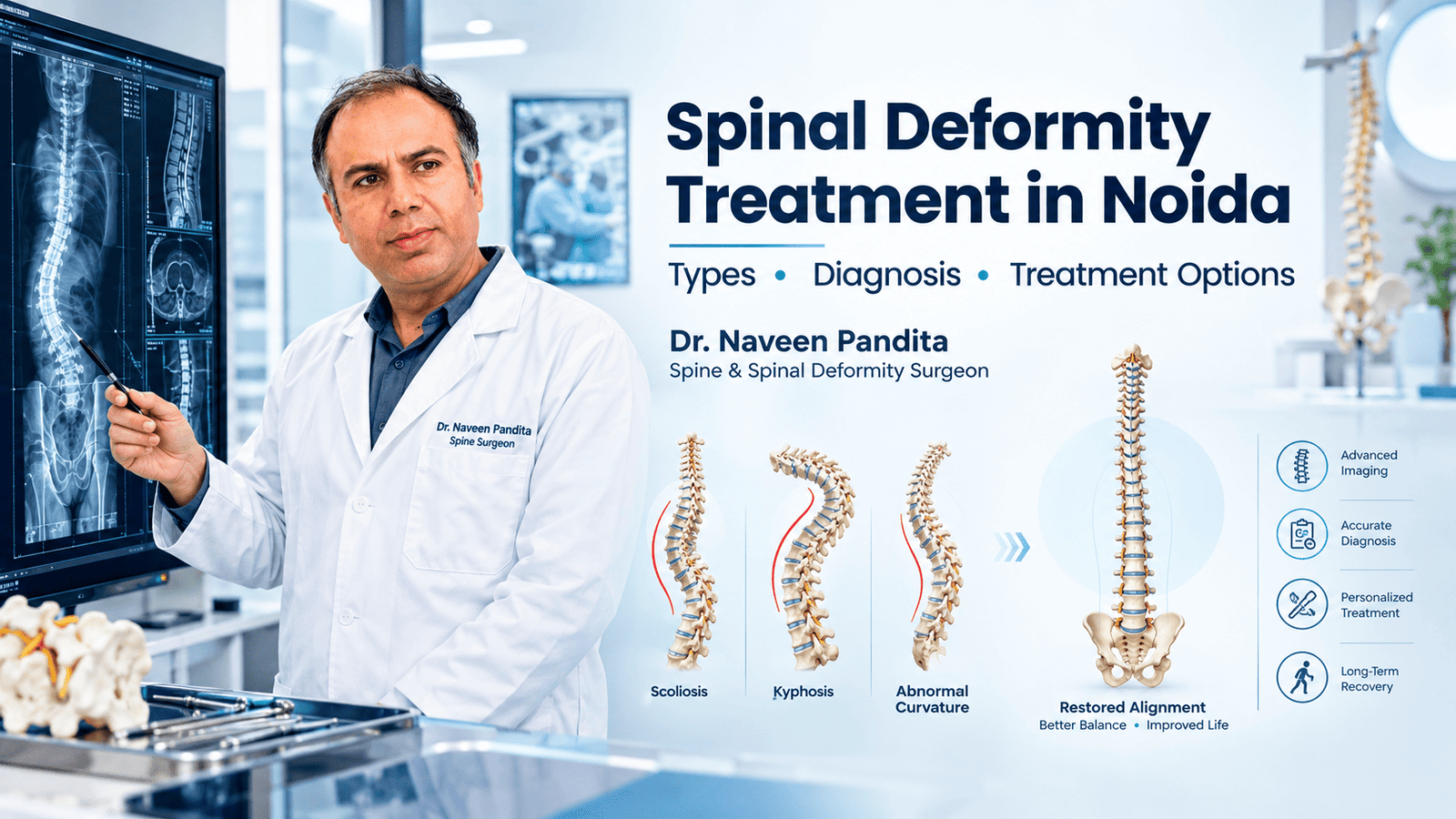
Spinal deformity refers to an abnormal curvature or alignment of the spine, and it can affect both children and adults. Conditions such as scoliosis and kyphosis fall under this broad category, ranging from mild curves that need monitoring to more complex deformities that affect posture, mobility, or nerve function. Because the causes, severity, and appropriate management of spinal deformity vary widely from person to person, specialist assessment is often an important step before choosing a treatment path. For patients in Noida and the wider Delhi NCR region, spinal deformity treatment in Noida typically begins with a clinical evaluation by a spine surgeon with specific experience in deformity conditions, such as Dr. Naveen Pandita, who focuses on spine and spinal deformity care.
Quick Answer: Spinal deformity treatment depends on the specific type of deformity, its severity and rate of progression, the patient’s age and symptoms, spinal alignment, and any neurological findings. Options range from simple observation and non-surgical management to spinal deformity correction surgery, which is generally reserved for select cases where non-surgical approaches have not adequately addressed the problem.
What Is Spinal Deformity?
Spinal deformity is an abnormal curvature, rotation, or alignment of the spine that differs from its typical shape. The spine naturally has gentle curves when viewed from the side, but when these curves become excessive, or when the spine curves abnormally from side to side, it is generally described as a deformity.
Spinal deformity can develop for several reasons:
- Congenital or developmental causes — some deformities are present from birth or emerge during growth, often related to how the vertebrae formed.
- Degenerative causes in adults — wear and tear of the discs and joints over time can gradually alter spinal alignment, particularly in older adults.
- Previous spine surgery — in some cases, spinal alignment changes can develop or become apparent after earlier spine procedures.
- Other causes, including certain neuromuscular conditions or trauma, may also contribute to spinal deformity in some patients.
It’s worth noting that not every spinal curve is a medical problem. Many curves are mild and never require treatment beyond periodic observation.
What Are the Common Types of Spinal Deformity?
Spinal deformity is not a single condition; it covers a range of presentations that differ by age group, direction of curvature, and complexity.
Scoliosis
Scoliosis is a sideways curvature of the spine, often combined with some rotation of the vertebrae. It can appear in children and adolescents (often without a clearly identifiable cause) or develop later in life due to degenerative changes.
Kyphosis
Kyphosis refers to an excessive forward-rounding curve of the upper back. Some degree of forward curve is normal, but when it becomes pronounced, it may affect posture and, in some cases, comfort or function.
Adult Spinal Deformity
Adult spinal deformity describes spinal curvature or malalignment that is diagnosed or becomes symptomatic in adulthood. It may be a continuation of a deformity from earlier life or a new degenerative change.
Pediatric Spinal Deformity
Pediatric spinal deformity refers to spinal curvature identified in infants, children, or adolescents. Because the spine is still growing, monitoring growth-related changes is often a key part of management.
Complex Spinal Deformity
Complex spinal deformity generally refers to cases involving multiple curves, significant rigidity, prior spine surgery, or coexisting neurological or structural factors that make evaluation and treatment planning more involved.
Not every type listed here requires surgical treatment; many patients, particularly those with mild or non-progressive curves, are managed with observation alone.
What Are the Symptoms of Spinal Deformity?
Symptoms of spinal deformity vary widely depending on the type, severity, and individual patient, and having one or more of these signs does not by itself confirm a diagnosis. Potential symptoms may include:
- The spine’s noticeable curvature.
- Uneven shoulders, waistline, and hips.
- Noticeable postural alterations
- Backache or pain
- Difficulty standing upright for long periods of time.
- Diminished flexibility or mobility.
- Symptoms of nerve involvement, including numbness, weakness, or changes in feeling.
Because these symptoms can also be caused by other spine or muscular conditions, a proper diagnosis requires clinical evaluation rather than self-assessment.
How Is Spinal Deformity Diagnosed?
Diagnosing spinal deformity typically starts with a detailed medical history and physical examination, during which a specialist assesses posture, spinal alignment, and any neurological signs.
Depending on the suspected condition, a specialist may recommend imaging studies, which can include:
- X-rays — often the first step, used to measure the degree and type of spinal curvature
- MRI — used when there is a need to evaluate the spinal cord, nerves, discs, or soft tissue in more detail
- CT imaging — Sometimes used for more detailed assessments of bone structure, particularly when planning complex care.
Depending on the circumstances, further tests, such as an assessment of overall health and any concomitant disorders that may affect treatment options, may be recommended. The results of the initial evaluation dictate the precise mix of tests utilised in a diagnosis.
What Is Adult Spinal Deformity Treatment?
Adult spinal deformity treatment is not a one-size-fits-all approach. The right course of action depends on a combination of factors that a spine specialist evaluates together, including:
- Severity of the curvature
- Symptoms the patient is experiencing
- Whether the deformity is progressing over time
- Age and overall general health
- Current spinal alignment
- Any neurological findings on examination
- History of previous spine surgery
- Impact on daily function and mobility
Many adults do not require surgery due to a spinal abnormality. Nonsurgical therapy, such as monitoring, activity adjustment, and pain management measures, may be useful, especially in milder or slowly developing instances. Surgical treatment is typically considered when symptoms are severe, the deformity is worsening, or non-surgical treatments have failed to appropriately address the patient’s condition. After a comprehensive evaluation, a trained spine surgeon can assist in determining which group a patient fits into.
What Are the Treatment Options for Spinal Deformity?
Non-Surgical Treatment
For many patients, especially those with mild or stable deformities, non-surgical approaches are the starting point. These may include:
- Observation — periodic monitoring through follow-up visits and imaging, particularly useful for mild or non-progressive curves
- Physical therapy involves targeted exercise to support posture, strength, and flexibility, as clinically recommended.
- Pain management strategies for patients experiencing discomfort
- Lifestyle or activity adjustment, when appropriate to the individual’s symptoms.
- Continuous monitoring to determine whether the malformation remains stable or progresses over time.
Spinal Deformity Correction Surgery
Spinal deformity correction surgery encompasses surgical techniques aiming at correcting spinal alignment and alleviating deformity-related symptoms. The precise surgical method is entirely dependent on the individual situation, including the nature, location, and severity of the deformity, as well as the patient’s overall health and previous surgical history.
It is critical to recognise that spinal deformity correction surgery cannot guarantee a perfectly “corrected” spine, pain reduction, or mobility gains. Surgical planning is tailored to each patient, and outcomes differ from one another. Any surgical recommendation should be based on a thorough discussion of the patient’s unique goals, predicted benefits, and potential dangers.
When Is Spine Deformity Correction Surgery Considered?
Surgery is not the first or only option for spinal deformity, and it is generally considered only in selected patients based on factors such as:
- Documented progression of the deformity over time
- Significant or worsening symptoms
- Meaningful impact on daily function
- Neurological involvement, such as nerve-related symptoms
- Limited improvement despite appropriate non-surgical management
- The overall severity and complexity of the deformity
Because these factors differ from patient to patient, determining whether to proceed with surgery requires a full specialist evaluation rather than a basic rule that applies to everyone with a spinal curvature.
Spine Deformity Correction Surgery in Noida and Delhi NCR
Patients considering spine deformity correction surgery in Noida typically choose a specialist who can provide a clear, targeted evaluation close to their home rather than travelling long distances for a first consultation. When dealing with scoliosis, kyphosis, adult spinal deformity, or other difficult presentations, having access to a spine surgeon with specific experience in spinal deformity rather than general spine care can be advantageous.
For residents across Noida, Ghaziabad, and Delhi NCR, specialised spinal deformity treatment is readily accessible locally. When choosing a specialist, relevant expertise in deformity evaluation, imaging, and surgical planning is key, though treatment decisions should ultimately be guided by individual clinical needs rather than proximity alone.
What Makes Complex Spinal Deformity Different?
Complex spinal deformity typically involves more than a single, straightforward curve. It may require:
- Detailed imaging to properly comprehend the shape and structure of the spine.
- Thorough examination of complete spinal alignment, not just one segment.
- Individualized surgical planning that accounts for the individual pattern of deformity.
- Consideration of any past spine procedures and how they impact current possibilities
- Evaluation of surrounding neurological structures, particularly the spinal cord and nerve roots, to establish whether a spinal cord-related problem coexists with the deformity.
- Before making any treatment decision, there should be a careful and frank discussion of realistic goals and potential hazards.
This is distinct from more general spinal deformity cases, and it’s also worth clarifying an important medical distinction: spinal deformity refers to the shape and alignment of the spine itself, while spinal cord–related conditions involve the nerve tissue that runs through the spinal canal. The two can sometimes coexist; for example, a significant deformity may in some cases affect the space available for the spinal cord or nerves, but spinal deformity treatment and spinal cord deformity treatment are not interchangeable terms, and any concerns involving the spinal cord specifically require careful, targeted neurological evaluation. As a Spine & Spinal Deformity Surgeon, this kind of layered evaluation, assessing both structural alignment and, where relevant, neurological involvement, is part of what complex deformity assessment involves.
How to Choose a Spine Deformity Specialist in Noida
Choosing the right specialist is an important part of the process, and patients may find it helpful to consider:
- Whether the surgeon has a specific focus on spinal deformity, not just general spine conditions
- Experience relevant to the specific type of deformity involved (pediatric, adult, or complex)
- Whether the specialist clearly explains the diagnosis and the reasoning behind treatment recommendations
- Whether non-surgical alternatives are discussed, not just surgical options
- A transparent explanation of potential risks and realistic expectations, not guarantees
- Access to appropriate imaging and diagnostic evaluation
- Whether there is adequate opportunity to ask questions and understand the plan
- Appropriate hospital or surgical infrastructure, in cases where surgery is being considered
A specialist’s own website being the source of this information does not, by itself, establish superiority; these are simply practical criteria patients can use to evaluate any specialist they are considering, in Noida or elsewhere.
Why Consider Dr Naveen Pandita for Spinal Deformity Evaluation?
Dr Naveen Pandita is a Spine & Spinal Deformity Surgeon based in Noida, serving patients across the Delhi NCR region. His clinical focus areas include complex spine, adult spinal deformity, pediatric spinal deformity, revision spine surgery, and minimally invasive spine surgery.
Patients considering a consultation for spinal deformity, whether newly diagnosed, previously treated elsewhere, or seeking a second opinion, can expect an evaluation that includes a review of symptoms, relevant imaging, and a discussion of the range of treatment options appropriate to their specific presentation, from observation and non-surgical care through to surgical correction where indicated.
Frequently Asked Questions About Spinal Deformity Treatment
What is spinal deformity?
Spinal deformity is an abnormal curvature, rotation, or alignment of the spine that differs from its typical shape. It includes conditions such as scoliosis and kyphosis and can affect children or adults, ranging from mild curves needing only monitoring to more complex presentations requiring specialist management.
What are the common types of spinal deformity?
Common types include scoliosis (sideways curvature with rotation), kyphosis (excessive forward rounding), adult spinal deformity, pediatric spinal deformity, and complex spinal deformity, which often involves multiple curves or additional structural and neurological considerations.
Can spinal deformity be treated without surgery?
Yes, in many cases. Mild or non-progressive deformities are often managed through observation, physical therapy where appropriate, pain management, and lifestyle adjustments. Surgery is generally reserved for cases involving significant symptoms, progression, or limited response to non-surgical care.
When is spinal deformity surgery recommended?
Surgery may be considered when the deformity is progressing, symptoms are significant, there is meaningful functional impairment or neurological involvement, or non-surgical management has not adequately addressed the condition. This decision is always individualized after specialist assessment.
What is adult spinal deformity?
Adult spinal deformity refers to spinal curvature or malalignment diagnosed or becoming symptomatic during adulthood. It may represent a deformity carried over from earlier life or a new change related to degenerative processes as the spine ages.
What is the difference between scoliosis and kyphosis?
Scoliosis is a sideways curvature of the spine, often with rotation, while kyphosis is an excessive forward-rounding curve, typically affecting the upper back. Both are types of spinal deformity but differ in the direction and pattern of the abnormal curve.
How is spinal deformity diagnosed?
Diagnosis typically involves a medical history, physical examination, and assessment of spinal alignment, often supported by imaging such as X-rays and, when clinically indicated, MRI or CT scans. The specific tests used depend on the individual case.
Where can I seek spinal deformity treatment in Noida?
Patients in Noida and the Delhi NCR region can seek evaluation from a spine surgeon with specific experience in spinal deformity, such as Dr. Naveen Pandita, who can review individual symptoms and imaging to guide an appropriate treatment plan.
Conclusion
Spinal deformity is not a single condition; it covers a wide spectrum of presentations, from mild scoliosis identified in adolescence to complex adult deformities involving multiple factors. The right treatment approach depends on the type of deformity, its severity, the patient’s age, symptoms, and a range of individual factors that only a thorough specialist evaluation can properly assess. Surgery is not the right path for every patient, and many cases are managed effectively through observation and non-surgical care.
For patients in Noida, Ghaziabad, and the wider Delhi NCR region, the first step toward clarity is usually a specialist evaluation rather than self-diagnosis based on symptoms alone.
Patients seeking evaluation for spinal deformity in Noida or Delhi NCR can schedule a consultation with Dr Naveen Pandita to discuss their symptoms, diagnosis and treatment options.