
Spinal Tumor Surgery in Noida: Diagnosis, Treatment, Surgery and Recovery
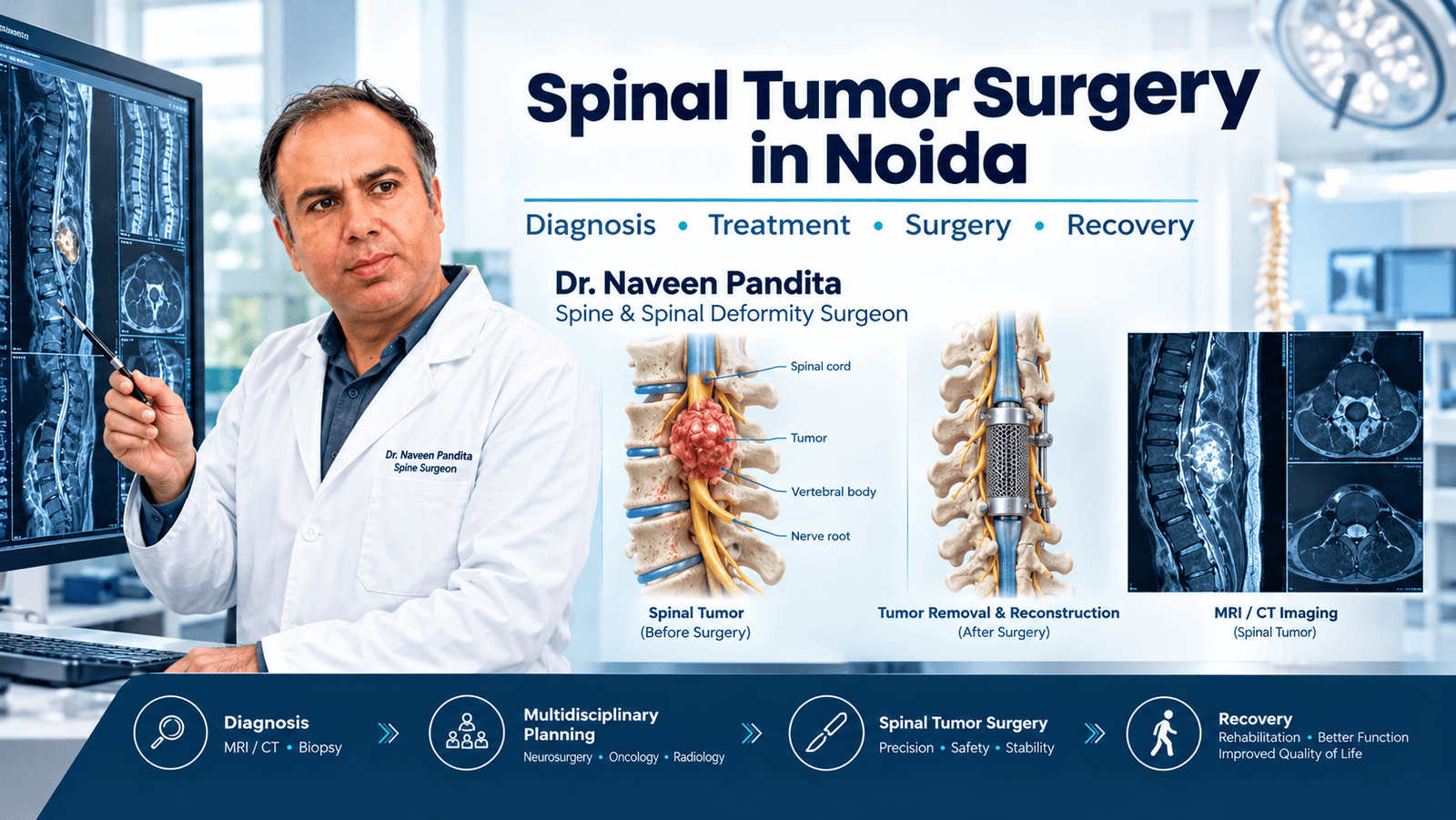
It is understandable to feel overwhelmed if you or a family member has recently been diagnosed with a spinal tumour, or if you are looking for spinal tumour surgery in Noida owing to unexplained back pain, paralysis, or unexpected imaging findings. A spinal tumour is a broad term that encompasses a wide range of growths that can develop within or around the spinal cord, nerves, vertebrae, or surrounding tissues. Some are slow-growing and innocuous for years, while others necessitate prompt treatment. Because the optimum method is determined by the specific tumour, its location, and how it affects the nervous system, a professional examination is essential prior to making any treatment decision. Dr Naveen Pandita, a Complex Spine and Spinal Deformity Surgeon in Noida, evaluates and manages patients with a wide range of spinal tumours, from straightforward cases to those requiring more intricate surgical planning.
This article explains what spinal tumours are, how they are diagnosed, when surgery becomes necessary, what surgery may involve, and what recovery generally looks like, so you can approach your next consultation with clarity rather than anxiety.
What Is a Spinal Tumor?
A spinal tumor is an abnormal growth of tissue occurring within the bones of the spine (vertebrae), the coverings of the spinal cord, the spinal cord itself, or the nerve roots that branch out from it. Tumours are broadly classified in a few important ways.
Primary versus metastatic: A primary spinal tumor originates in the spine itself, arising from bone, nerve tissue, or the membranes surrounding the spinal cord. A metastatic (secondary) tumour, on the other hand, spreads to the spine from cancer elsewhere in the body, such as the breast, lung, prostate, kidney, or thyroid. Metastatic tumours are actually more common than primary spinal tumours in adults.
Benign versus malignant: Benign tumours do not spread to other parts of the body, but depending on their size and location, they can still press on the spinal cord or nerves and cause significant symptoms. Malignant tumours can grow more aggressively and, in the case of metastases, reflect cancer that has already spread from another organ.
Structures involved: Tumours can affect the vertebral bones, the space around the spinal cord, the delicate membrane (dura) covering the cord, the spinal cord tissue itself, or the nerve roots exiting the spine. This anatomical distinction matters enormously for treatment planning, which is discussed further below.
What Are the Symptoms of a Spinal Tumor?
Spinal tumours can present in many ways, and, importantly, most people with these symptoms do not have a tumour. Common causes of back and neck pain are far more frequent than spinal tumours. Still, certain patterns warrant closer evaluation:
- Back pain or neck pain that does not go away or intensifies progressively.
- Pain that wakes you up at night or persists even when you are asleep.
- Pain that spreads to an arm, leg, or body.
- Symptoms may include numbness, tingling, and increasing weakness in the arms or legs.
- Change in gait or difficulty walking
- Loss of balance or coordination
- New bladder or bowel changes, such as trouble controlling urination.
Having one or more of these symptoms does not automatically indicate a spinal tumour; mechanical back pain, disc problems, and other spinal conditions are far more common explanations. However, symptoms that are progressive, unexplained, or accompanied by neurological changes deserve a proper clinical assessment rather than prolonged self-management.
Types of Spinal Tumors
Spinal tumours are generally categorised by their location relative to the spinal cord and its coverings. This classification directly influences how a surgeon approaches evaluation and, when needed, surgery.
Intramedullary Spinal Tumours
These tumours arise from within the spinal cord tissue itself. Because the spinal cord is a delicate structure responsible for transmitting nerve signals throughout the body, tumours in this location require particularly careful surgical planning to protect neurological function.
Intradural Extramedullary Tumours
These develop within the dural covering of the spinal cord but outside the cord tissue itself, for example, arising from the nerve roots or the membranes surrounding the cord. They are often more accessible surgically than intramedullary tumours, though this varies by size and exact location.
Extradural and Vertebral Tumours
These tumours arise outside the dura, often involving the vertebral bone itself. This category includes many metastatic tumours as well as some primary bone tumours of the spine. When bone is involved, spinal stability becomes an important consideration alongside neurological compression.
Tumour location affects nearly every aspect of surgical planning, the surgical approach, the risk of neurological injury, whether stabilisation is needed, and how much of the tumour can be safely removed. This is why an accurate anatomical diagnosis, established through imaging, is the starting point for any treatment discussion.
How Is a Spinal Tumor Diagnosed?
Diagnosis begins with a detailed clinical history and a thorough neurological examination, assessing strength, sensation, reflexes, coordination, and gait. This helps identify which parts of the nervous system may be affected and how urgently further evaluation is needed.
Imaging plays a central role:
- MRI (Magnetic Resonance Imaging) is the most common approach for detecting spinal malignancies because it provides detailed images of the spinal cord, nerves, and soft tissues.
- Contrast-enhanced MRI is commonly used because certain cancers exhibit distinct patterns that help narrow down the likely diagnosis.
- CT scans can be used to examine bone involvement, vertebral structural integrity, and bone-related surgical procedures.
- When a metastatic tumor is suspected, PET/CT or other systemic imaging may be used to rule out a primary cancer elsewhere or to determine the extent of the disease.
- Biopsy or tissue diagnosis is sometimes required, particularly when the tumor type cannot be confirmed only from imaging, because the exact pathology has a substantial impact on treatment options.
The exact diagnostic pathway is individualised; not every patient requires every test, and the sequence depends on what is suspected based on the initial findings.
When Is Spinal Tumor Surgery Needed?
One of the most important things for patients to understand is that not every spinal tumor requires surgery. Some slow-growing, asymptomatic tumours are monitored with periodic imaging rather than treated immediately. Surgery is generally considered when one or more of the following apply:
- There is significant compression of the spinal cord or nerves
- Neurological symptoms are progressive, with worsening weakness, numbness, or coordination problems
- The spine has become unstable or is at risk of instability due to bone involvement
- There is progressive spinal deformity related to the tumour
- Pain is severe and not controlled by other measures
- A tissue diagnosis is needed and cannot be obtained safely without surgery
- The tumour is enlarging on serial imaging
In other situations, observation, radiotherapy, systemic (medical) cancer treatment, or a combination of these may be more appropriate than surgery, particularly for certain metastatic tumours, tumours in surgically difficult locations with minimal symptoms, or when a patient’s overall health makes surgery higher risk than the tumour itself. This is why treatment planning for spinal tumours is often multidisciplinary, involving surgeons, oncologists, and radiation specialists working together.
What Does Spinal Tumor Surgery Involve?
Spinal tumor surgery is not a single standardised procedure; it varies considerably depending on the tumour’s location, size, and relationship to the spinal cord, nerves, and bone. Depending on the specific case, surgery may involve:
- Decompression – relieving pressure on the spinal cord or nerve roots
- Tumour resection – removing part or all of the tumour, when this can be done safely
- Microsurgical techniques – using an operating microscope for precision when working near the spinal cord or nerves
- Intraoperative neuromonitoring – tracking nerve signals in real time during surgery to help protect neurological function
- Spinal reconstruction and instrumented stabilisation – using rods, screws, or cages when tumour removal or bone involvement affects spinal stability
- Vertebral reconstruction – rebuilding the load-bearing portion of the spine when a vertebra has been significantly affected
Not all of these elements apply to every patient. A small intradural tumour may require a relatively focused procedure, while a large vertebral tumour causing instability may require a more extensive reconstruction. The surgical plan is built around the individual patient’s imaging findings and overall condition.
Complex Spinal Tumor Surgery in Noida
Some spinal tumours are anatomically straightforward to access and remove. Others are genuinely complex, for instance, tumours that involve the spinal cord directly, sit close to major blood vessels, extend across multiple spinal levels, involve both the front (vertebral body) and back (posterior elements) of the spine, or occur alongside spinal instability or deformity.
These difficult patients necessitate meticulous preoperative preparation, including a thorough assessment of imaging, a grasp of spinal biomechanics, and, in many cases, a phased or combination surgical strategy. Dr Naveen Pandita, a Complex Spine and Spinal Deformity Surgeon in Noida, specialises in this type of spinal pathology, in which tumour removal must be balanced against neurological function and the maintenance of a stable, supportive spine. Patients in Noida, Greater Noida, Ghaziabad, Vaishali, and throughout Delhi NCR who want to be evaluated for complex spinal tumours can get an individualised examination of their imaging and clinical results.
Schedule a consultation for complex spinal tumour evaluation, in-person or with prior imaging review.
Risks and Complications of Spinal Tumor Surgery
As with any spinal surgery, spinal tumour surgery carries risks that vary depending on tumour location, size, biology, and how closely it is related to the spinal cord and nerves. Potential risks include:
- Infection
- Bleeding
- Cerebrospinal fluid (CSF) leak
- Injury to the spinal cord or nerve roots, which can affect movement or sensation
- Spinal instability requiring stabilisation
- Tumour recurrence
- Incomplete tumour removal, when complete removal would carry unacceptable risk to neurological structures
- General risks related to anaesthesia and major surgery
These risks are discussed individually with each patient, since a small, well-defined tumour away from critical structures carries a different risk profile than a large tumour intimately involving the spinal cord or major blood vessels. No surgeon can promise a risk-free outcome, and any responsible discussion of spinal tumour surgery includes an honest account of these possibilities.
Recovery After Spinal Tumor Surgery
Recovery is influenced by the type of surgery performed, the tumour’s location, and the patient’s neurological status before and after surgery. In general, recovery involves:
- A hospital stay for monitoring, pain control, and early mobilisation
- Close neurological monitoring in the initial post-operative period
- Physiotherapy when weakness or mobility issues are present
- Wound care and monitoring for signs of infection or CSF leak
- Follow-up imaging to assess the surgical site
- Histopathology (tissue) review to confirm the exact tumour type
- Additional treatment, such as radiotherapy or systemic therapy, when the pathology results indicate this is needed
Recovery timelines differ significantly between patients and cannot be generalised into a single expected schedule. Someone undergoing a focused decompression may mobilise sooner than someone recovering from extensive reconstruction. Your surgical team will guide you through a realistic, individualised recovery plan based on your specific procedure.
Spinal Tumor Surgery Cost in Noida
Many patients searching for spinal tumour surgery in Noida understandably want to know about the cost. However, providing a fixed figure would be misleading, because spinal tumour surgery cost depends on multiple variables, including:
- The type and location of the tumour
- The complexity of the surgical approach
- The number of spinal levels involved
- Whether implants or reconstruction are required
- The need for intraoperative neuromonitoring
- Length of ICU or hospital stay
- Pathology and laboratory testing
- Any additional oncology treatment required after surgery
An accurate cost estimate can only be given after clinical evaluation, imaging review, and surgical planning, since these factors differ from patient to patient.
Why Choose a Complex Spine Surgeon for Spinal Tumor Surgery?
When researching a spinal tumor surgeon or spinal tumour specialist, it is worth focusing on factors that genuinely affect care quality rather than generic claims. Relevant considerations include:
- Specific training and experience in complex spinal pathology, not general spine surgery alone
- Experience managing tumours that involve the spinal cord or nerve roots
- Familiarity with spinal reconstruction and stabilisation techniques when bone is involved
- Access to appropriate imaging and, where indicated, intraoperative neuromonitoring
- Ability to coordinate multidisciplinary care with oncology and radiation specialists when needed
- Hospital infrastructure suited to complex spinal procedures
- A willingness to individualise the treatment plan rather than apply a one-size-fits-all approach
These are the practical questions worth discussing during a consultation, rather than relying on marketing claims.
Frequently Asked Questions About Spinal Tumor Surgery in Noida
Is every spinal tumor cancerous?
No. Spinal tumours can be benign or malignant. Many primary spinal tumours are benign, while metastatic spinal tumours, by definition, arise from cancer elsewhere in the body.
When does a spinal tumor require surgery?
Surgery is generally considered when there is significant nerve or spinal cord compression, progressive neurological symptoms, spinal instability, uncontrolled pain, or when tissue diagnosis is needed. Not every tumour requires surgery.
Is spinal tumor surgery risky?
Like all spine surgery, it carries risks, including infection, bleeding, CSF leak, and potential neurological injury. Risk levels vary depending on tumour location and complexity, and are discussed individually with each patient.
Can a spinal tumor be completely removed?
In some cases, yes. In others, complete removal may not be safe due to the tumour's proximity to the spinal cord or nerves, in which case partial removal combined with other treatments may be recommended.
How long does spinal tumor surgery take?
Duration varies widely based on tumour size, location, and whether reconstruction is needed, ranging from a few hours for focused procedures to significantly longer for complex, multi-level surgery.
How long is recovery after spinal tumor surgery?
Recovery time depends on the extent of surgery and the patient's neurological status. Some patients recover over weeks, while more extensive procedures may require a longer, structured rehabilitation period.
What is the cost of spinal tumor surgery in Noida?
Cost depends on tumour type, surgical complexity, implants used, hospital stay, and additional treatment needs. An accurate estimate requires individual evaluation.
Which specialist treats spinal tumors?
Spinal tumors are typically managed by spine surgeons with experience in complex spinal pathology, often working alongside neurosurgeons, oncologists, and radiation specialists as needed.
Can spinal tumors cause paralysis?
If left untreated, tumours causing significant spinal cord compression can potentially lead to progressive weakness or paralysis. This is why progressive neurological symptoms should be evaluated promptly.
When should I urgently see a spine specialist?
Seek prompt evaluation if you experience progressive weakness, new difficulty walking, loss of coordination, new bowel or bladder dysfunction, or rapidly worsening neurological symptoms.
When Should You Consult a Spine Specialist?
While many spinal symptoms are not caused by tumours, certain warning signs should prompt timely evaluation rather than a wait-and-watch approach:
- Progressive weakness in an arm or leg
- New or worsening difficulty walking
- Loss of coordination or balance
- New bowel or bladder dysfunction
- Progressive numbness or spreading sensory changes
- Severe or rapidly worsening neurological symptoms of any kind
These symptoms warrant a clinical assessment and, typically, MRI imaging to determine the underlying cause.
Conclusion
Spinal tumours are a diverse group of conditions, and there is no single treatment path that applies to every patient. The right approach depends on the tumour’s type, location, size, relationship to the spinal cord and nerves, and its effect on spinal stability; surgery is not automatically the answer for every case. Complex tumours, in particular, require careful assessment of anatomy, neurological risk, and spinal stability before any decision is made.
If you are in Noida, Greater Noida, Ghaziabad, Vaishali, or elsewhere in Delhi NCR and have been advised to seek evaluation for a spinal tumour, a detailed clinical assessment and imaging review is the appropriate next step. Dr Naveen Pandita, Complex Spine and Spinal Deformity Surgeon in Noida, provides individualised evaluation for patients with spinal tumours, helping determine whether observation, surgery, or a multidisciplinary treatment approach is most appropriate for your specific situation. If you have concerning symptoms or imaging findings, consider scheduling a consultation to discuss your case in detail.
Schedule a consultation with Dr Naveen Pandita to discuss your case and treatment options