
Complex Spine Revision Surgery in Noida: When Is Revision Spine Surgery Needed?
Introduction
Not all spine surgeries go as planned, and not all patients heal as predicted. Some people still have back or leg pain after surgery. Others feel better for a few years until their problems reappear. A smaller proportion of patients develop new issues, such as weakness, unbalance, or difficulty standing upright, that weren’t present before the initial procedure.
When this happens, patients typically start looking for complex spine revision surgery in Noida to understand whether a second procedure is necessary and, if so, what it entails.
Revision spine surgery is a specialist subspecialty of spine care. It is more than just “doing the same operation again.” It frequently entails working through scar tissue, previous implants, and altered anatomy while attempting to solve a problem that may be more complex than the original. This article describes in layman’s terms what complex revision spine surgery is, why it is required, how it is evaluated, and what patients in Noida, Greater Noida, Delhi, Ghaziabad, Vaishali, and the Delhi NCR region should know before undergoing it.
This article is intended to provide general education and should not be used in place of an individual clinical examination. Every spine is unique, and any choice of revision surgery should be based on a hands-on evaluation by a trained spine surgeon.
What Is Complex Spine Revision Surgery?
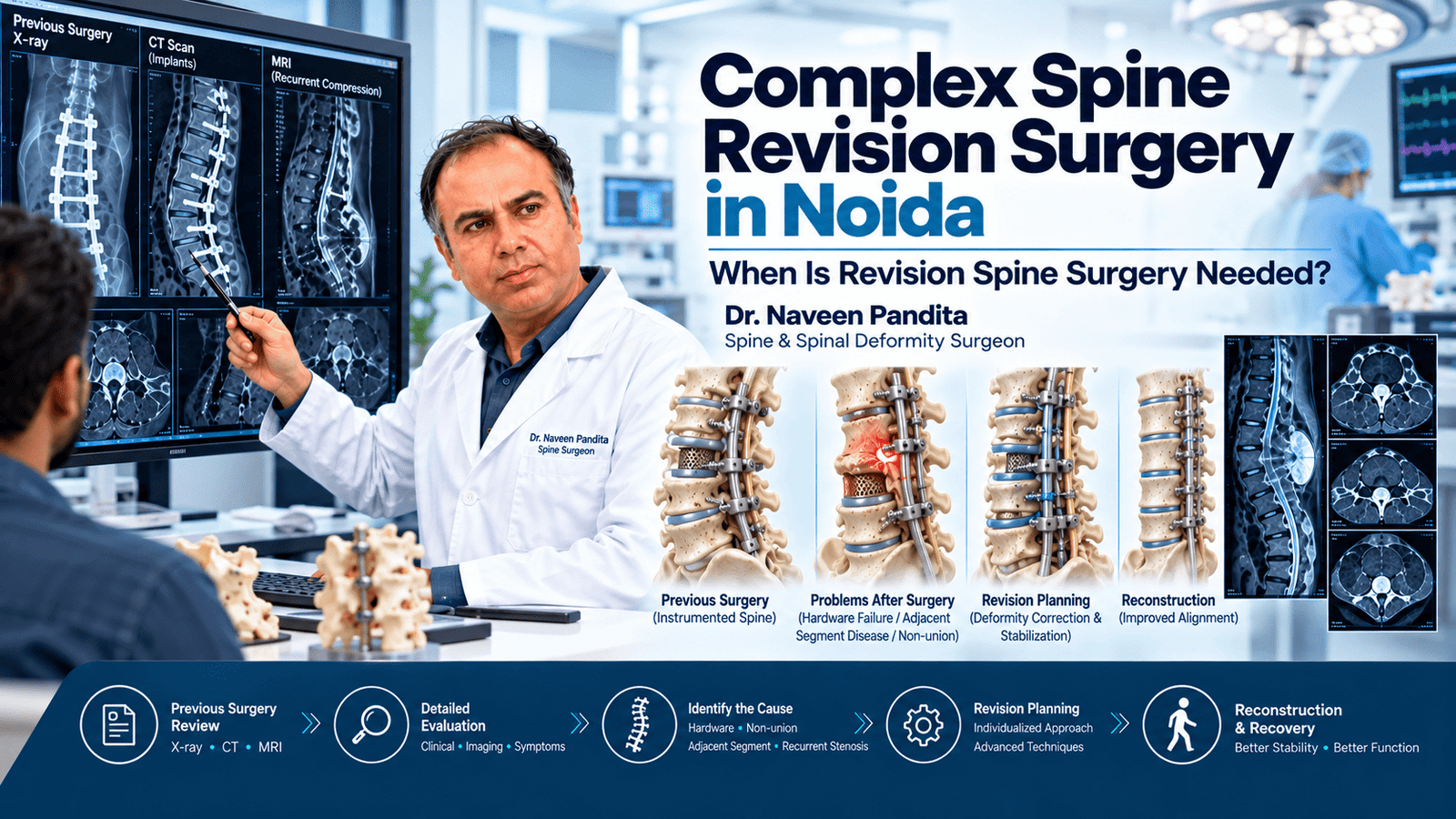
Complex spine revision surgery in Noida refers to a second (or subsequent) spinal operation performed to correct, repair, or improve upon the outcome of a previous spine surgery, often involving scar tissue, existing implants, altered anatomy, or a combination of structural problems that make the procedure more demanding than a first-time operation.
Not all revision procedures are equally complex. A straightforward revision might involve removing a small amount of recurrent disc material at a single level. A complex revision, on the other hand, may involve:
- Multiple surgeries at the same or nearby levels.
- Removal or replacement of existing screws, rods, or cages.
- Correction of a long-term spinal malformation or imbalance
- Spinal reconstruction due to bone loss, implant failure, or non-union
- To obtain proper correction and stability, use combined methods (from the front, side, and rear of the spine).
The term “complex” generally reflects the technical difficulty, the number of levels involved, the presence of prior hardware, and the degree of anatomical distortion, not the emotional difficulty of the patient’s situation, though that is important too.
Why Do Patients Need Revision Spine Surgery?
Spine surgery has a well-established role in treating nerve compression, instability, and deformity. However, like any surgery, outcomes are not always permanent or complete. There are several recognised reasons a second surgery may become necessary.
Common Causes of Failed Spine Surgery
- Recurrent disc herniation — a fresh disc fragment at the same level as a previous discectomy
- Persistent or recurrent nerve compression — inadequate decompression the first time, or new compression from scar tissue or bone regrowth
- Spinal stenosis — narrowing that develops or progresses at the same or a different level
- Pseudarthrosis (non-union) — the bones intended to fuse never actually joined together.
- Implant failure — screws, rods, or cages that loosen, break, or migrate
- Adjacent segment disease — increased stress on the spinal levels next to a previous fusion, leading to new degeneration
- Progressive spinal deformity — worsening curvature or malalignment despite previous correction
- Postoperative instability — abnormal movement between vertebrae after decompression or partial fusion
- Infection — deep or superficial infection involving the wound or implants
- Sagittal imbalance — a forward-leaning posture that develops after fusion, affecting standing and walking
- Junctional problems — new deformity or fracture occurring just above or below a fused segment
- Persistent pain with an identifiable structural cause — when imaging and examination point to a correctable problem, rather than pain alone
It’s worth underlining that persistent pain by itself is not automatically a reason for revision surgery. Pain has to be correlated with a clear, correctable structural finding before another operation is considered.
When Is Complex Revision Spine Surgery Considered?
This is one of the most important questions patients ask, and the honest answer is: revision surgery is considered when there is a specific, identifiable structural problem that correlates with the patient’s symptoms, not simply because symptoms have returned or never fully resolved.
A responsible spine surgeon does not decide on revision surgery based on pain scores or patient frustration alone, however genuine those concerns are. Instead, the decision relies on bringing together:
- Symptoms – what the patient is actually feeling (pain pattern, weakness, numbness, walking problems, deformity.
- Clinical examination – neurological testing, posture and gait evaluation, movement patterns, and site-specific findings.
- Imaging – MRI, CT, and X-rays that indicate the current status of the spine, not simply records.
- Previous operative history – what was actually done in the previous surgery, which levels were treated, what implants were used, and how the recuperation progressed.
When these four elements line up, when the imaging clearly explains the symptoms, and the symptoms match what was found on examination, revision surgery becomes a reasonable option to discuss. When they don’t line up, further non-surgical evaluation, pain management, or a period of observation may be more appropriate first.
Why Is Revision Spine Surgery More Challenging?
Revision spine surgery is generally more technically demanding than first-time spine surgery because the surgeon is operating through altered anatomy, often near or around implants that are already in place, with less predictable tissue planes.
Some of the specific challenges include:
- Scar tissue (epidural fibrosis) — Previous surgery creates scarring around the nerves and spinal canal, making it more difficult to determine normal anatomical planes and increasing the risk of unintended harm to the dura (the spinal cord and nerves’ covering) during dissection.
- Landmarks that a surgeon would typically rely on may be absent, displaced, or disguised as a result of previous bone removal or fusion.
- Previous implants – Existing screws, rods, or cages may need to be examined, removed, replaced, or worked around, necessitating meticulous preoperative planning.
- Bone loss – Repeated treatments might diminish the quantity of healthy bone available for fixation, necessitating bone grafts or specialist implant techniques.
- Distorted tissue planes – Muscles and soft tissues that have healed after a previous operation don’t separate as cleanly, extending operative time and requiring meticulous technique.
- Neurological and vascular considerations – Nerves and, in some regions of the spine, major blood vessels may lie closer to scarred tissue, demanding extra caution.
- Need for reconstruction or deformity correction – Some revision cases are not just about removing a problem but rebuilding spinal alignment and stability from a compromised starting point.
This combination of factors is why complex revision spine surgery in Noida is typically approached by surgeons who specifically focus on this area of spine care, rather than being treated as a routine repeat of the original procedure.
What Investigations Are Needed Before Revision Spine Surgery?
Good decision-making in revision spine surgery depends heavily on accurate, up-to-date imaging and a clear understanding of what was done previously.
Typical Evaluation Includes
- MRI scan to assess nerve compression, disk disease, scar tissue, and soft tissue detail (with or without contrast, depending on the clinical question)
- CT scans are extremely effective for evaluating bone quality, fusion status, implant position, and pseudarthrosis.
- Standing (weight-bearing) X-rays are important for assessing spinal alignment, balance, and instability under normal load, which lying-down scans may not always reveal.
- Flexion-extension X-rays are occasionally used to diagnose abnormal movement between vertebrae..
- When an infection is suspected, a blood test is ordered.
- Nerve conduction exams, or EMGs, are occasionally used to determine whether chronic symptoms are caused by nerve compression or another nerve condition.
- Bone density testing is relevant in several revision circumstances, particularly when a new fixation is offered in older patients.
Because every patient’s situation is different, not every investigation is needed in every case. The surgeon determines what is clinically relevant based on the initial consultation and examination.
Types of Complex Revision Spine Surgery
Revision procedures vary considerably depending on the underlying problem. Broad categories include:
1. Revision Decompression
Removing new or residual pressure on nerves caused by recurring disk material, regrown bone (restenosis), or thickened scar tissue that compresses the nerve roots or spinal cord.
2. Revision Fusion
A recurrence or enlargement of a fusion that has not healed properly (pseudarthrosis) or one that wants to be redone because of implant troubles.
3. Implant Revision
To remove, reinstall, or replace loose, broken, and now no longer functioning screws, rods, cages or different hardware as intended
4. Pseudarthrosis Reconstruction
Addressing a non-healed fusion may necessitate new bone grafts, revised fixation, and, in certain cases, a different surgical strategy than the original procedure.
5. Deformity Correction
Correcting increasing curvature, imbalance, or malalignment that has resulted from previous surgery, which may necessitate significant restoration at numerous levels.
6. Spinal Reconstruction
Rebuilding structural support in the spine where bone loss, infection, or implant failure has compromised the original construct.
7. Multilevel Revision Surgery
Addressing problems that span several spinal segments, often combining decompression, fusion, and alignment correction in a single planned procedure.
8. Anterior, Lateral, or Posterior Reconstruction
Depending on the exact affliction, the general practitioner may also need to perform an anterior (anterior), lateral (lateral), or repeat (posterior) spinal procedure for good enough correction and stability, or perform a combination approach.
What Are the Risks of Complex Revision Spine Surgery?
Every surgical procedure carries risk, and revision spine surgery is no exception. Because of the technical challenges discussed earlier, some risks are relatively higher in revision cases compared to first-time surgery. A balanced, honest understanding of this is important before making any decision.
Potential risks and considerations include:
- Higher risk of dural tear (a small opening in the covering of the nerves) due to scar tissue
- Increased blood loss compared to first-time surgery, related to scarring and dissection through previously operated tissue
- Longer operative time
- Risk of infection, particularly when hardware is involved
- Risk of nerve or, rarely, vascular injury
- Possibility of incomplete symptom relief, since revision surgery addresses identifiable structural problems and cannot guarantee complete resolution of all pain
- Risk of non-union (pseudarthrosis) even after revision fusion
- General anaesthesia-related risks, and risks related to any pre-existing medical conditions
- The possibility that further surgery may be needed in the future, depending on the underlying condition
No responsible surgeon can promise a guaranteed outcome or a “100% success rate.” What a good surgical plan can offer is a carefully considered, individualised approach designed to address the identified problem, along with an honest discussion of what surgery can realistically achieve.
Recovery After Revision Spine Surgery
Recovery after revision spine surgery is variable and depends on several factors, including:
- The underlying issue being addressed.
- Surgical complexity (number of stages, extent of reconstruction).
- Whether fusion, deformity correction, or reconstruction was carried out.
- The patient’s neurological condition before and after operation.
- Overall health, bone quality, and any preexisting medical issues.
- Adherence to postoperative procedures and rehabilitation.
In general, patients should anticipate a period of limited activity following surgery, followed by gradual mobilisation under observation and a structured rehabilitation plan. Because bone healing takes time, fusion-based operations typically necessitate a longer period of rehabilitation before resuming more strenuous exercise. Regular follow-up, including imaging, is usually required to assess healing and watch for complications such as pseudarthrosis or implant-related issues.
Patients should have a candid conversation with their surgeon about predicted recovery times for their specific procedure rather than relying on general timeframes.
Why Choose a Complex Spine and Spinal Deformity Surgeon?
Given the technical demands described above, scar tissue, altered anatomy, existing implants, and sometimes the need for deformity correction, complex revision cases benefit from evaluation by a surgeon whose practice specifically includes this type of work, rather than being treated purely as routine repeat surgery.
Dr Naveen Pandita is a Complex Spine and Spinal Deformity Surgeon in Noida, with a practice focused on complex spinal reconstruction, revision spine surgery, spinal deformity correction, minimally invasive spine surgery, and endoscopic spine surgery, in addition to challenging primary spinal procedures.
Evaluating a revision case involves more than reviewing a single scan. It requires piecing together the patient’s full surgical history, correlating old and new imaging, understanding what was done in the previous operation(s), and building a surgical plan that accounts for altered anatomy and existing hardware. This kind of detailed, case-specific planning is central to how complex revision spine surgery is approached.
Consultation for Complex Spine Revision Surgery in Noida
Patients from Noida, Sector 26, Greater Noida, Delhi, Ghaziabad, Vaishali, East Delhi, and the wider Delhi NCR region who are dealing with persistent or recurring symptoms after previous spine surgery may benefit from a focused evaluation with a spine specialist experienced in revision and complex reconstructive cases.
Consultations are available at:
Noida Sports Injury Centre Clinic, Sector 26, Noida, Uttar Pradesh
What Should You Bring to a Revision Spine Consultation?
Because revision surgery planning depends heavily on understanding exactly what was done previously, it is very helpful to bring as much of the following as possible to your first consultation:
- Previous MRI scans (films or digital copies, not just reports)
- Previous CT scans, if performed
- Previous X-rays, including any standing or flexion-extension views
- Operative notes from the earlier surgery or surgeries
- Implant information, the type, brand, or size of screws, rods, or cages used, if available (sometimes found on an implant card given at the time of surgery)
- Previous discharge summaries
- Histopathology reports, if any tissue was sent for testing during earlier surgery
- Records of any previous treatments tried, including physiotherapy, injections, or medications.
- A list of current medications
Bringing this information helps the surgeon build an accurate picture of your spine’s history, which is often the single most important factor in planning a safe and appropriate revision strategy. If you no longer have physical copies, most hospitals and diagnostic centres can provide digital copies on request.
What Happens During Evaluation?
A typical evaluation for suspected complex revision spine surgery includes a detailed history of the original problem and previous surgery, a physical and neurological examination, a review of prior imaging, as well as any new scans that may be required, and a discussion of findings, options, and reasonable expectations. Some patients may require additional investigations before a solid recommendation can be given, and non-surgical therapy may still be necessary rather than continuing directly to another operation.
If you are dealing with persistent, recurring, or new symptoms after a previous spine surgery, a focused evaluation can help clarify whether revision surgery is a relevant option for your specific situation. Book a consultation with Dr Naveen Pandita at Noida Sports Injury Centre Clinic, Sector 26, Noida, to discuss your case in detail.
Frequently Asked Questions
What is complex spine revision surgery?
Complex spine revision surgery is a repeat spinal operation performed to address problems remaining or developing after a previous spine surgery, often involving scar tissue, prior implants, and altered anatomy that make it more technically demanding than first-time surgery.
When is revision spine surgery required?
Revision spine surgery is generally considered when a patient has persistent or new symptoms that correlate with a specific, identifiable structural problem on imaging, such as recurrent disc herniation, implant failure, or non-union, rather than for pain alone.
Why does spine surgery sometimes need to be revised?
Spine surgery can require revision due to recurrent disc herniation, incomplete decompression, non-union of a fusion, implant loosening or failure, adjacent segment degeneration, progressive deformity, or, less commonly, infection.
What is failed back surgery syndrome?
Failed back surgery syndrome refers to persistent or recurrent pain after spine surgery. It is a descriptive term rather than a single diagnosis, and identifying its exact cause requires careful clinical and imaging evaluation before deciding on any further treatment, surgical or otherwise.
When is revision spinal fusion considered?
Revision spinal fusion may be considered when a previous fusion has not healed (pseudarthrosis), when hardware has failed, or when instability or deformity has developed at or near a previously fused segment, and these findings correlate with the patient's symptoms.
Can a failed spinal fusion be corrected?
In many cases, a failed or non-united spinal fusion can be addressed through revision surgery involving improved fixation, bone grafting, and sometimes a different surgical approach, though outcomes depend on the individual case and cannot be guaranteed.
What happens during complex revision spine surgery?
The specific steps depend on the underlying problem, but complex revision surgery may involve removing scar tissue, addressing recurrent compression, revising or replacing implants, correcting alignment, and reconstructing the spine, guided by preoperative imaging and planning.
Is revision spine surgery more difficult than the first surgery?
Yes, in general. Revision surgery involves working around scar tissue, previous implants, and altered anatomy, which typically increases technical difficulty compared with a first-time procedure.
What investigations are needed before revision spine surgery?
Common investigations include MRI, CT scans, standing X-rays, and sometimes flexion-extension X-rays, blood tests, or nerve studies, depending on the clinical picture and what needs to be evaluated.
What are the risks of revision spine surgery?
Risks can include dural tear, increased blood loss, infection, nerve injury, incomplete symptom relief, and non-union, among others. Risk profiles vary by case, and a surgeon can explain the specific risks relevant to an individual patient's situation.
How long does recovery take after revision spine surgery?
Recovery time varies significantly based on the complexity of the surgery, whether fusion or reconstruction was performed, and the patient's overall health. A surgeon can provide a more specific expected timeline based on the exact procedure planned.
Where can patients consult a complex spine surgeon in Noida?
Patients can consult Dr. Naveen Pandita, Complex Spine and Spinal Deformity Surgeon, at Noida Sports Injury Centre Clinic, Sector 26, Noida, Uttar Pradesh.
Conclusion
Needing a second spinal surgery can be disappointing, especially after undergoing one procedure and recovery. However, revision surgery is a well-known element of spine treatment, and for the right patient with the right diagnosis, it can alleviate problems that would otherwise continue in daily life.
Before deciding whether complex spine revision surgery in Noida is the best option, a complete, tailored review of symptoms, examination findings, imaging, and a thorough understanding of the previous operation is essential. Because these cases involve scar tissue, existing implants, and sometimes severe anatomical changes, they should be assessed by a surgeon who specialises in complex and revision spinal procedures.
If you or a family member in Noida, Greater Noida, Delhi, Ghaziabad, Vaishali, or the wider Delhi NCR region is dealing with ongoing or recurring symptoms after spine surgery, a detailed specialist evaluation is the most reliable way to understand your options. Consultations are available with Dr Naveen Pandita at Noida Sports Injury Centre Clinic, Sector 26, Noida.