Scoliosis Surgery in Noida: Expert Spinal Deformity Care by Dr Naveen Pandita
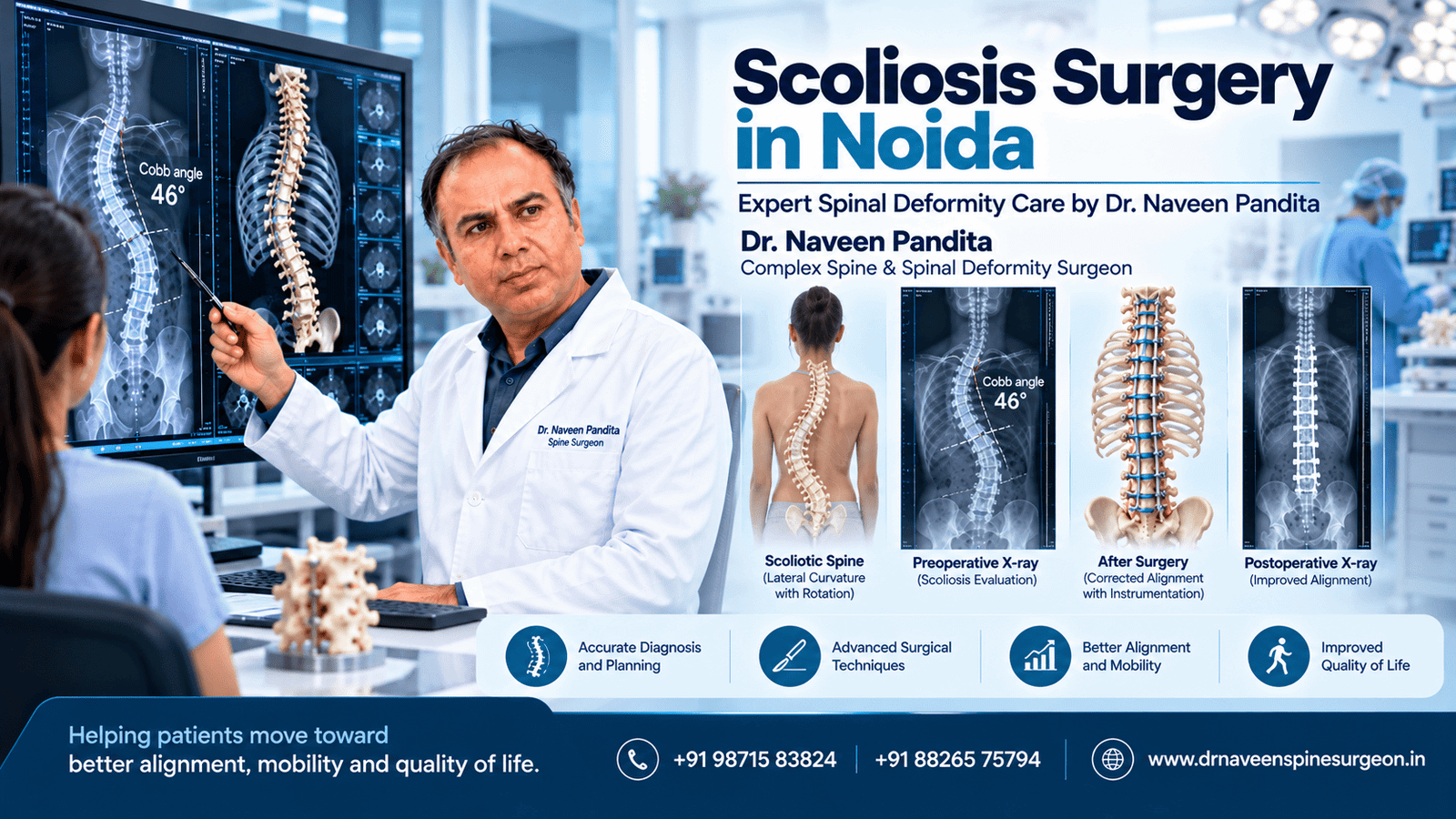
Scoliosis surgery in Noida is considered when a spinal curve is large, progressing, painful, or affecting nerve function, and when non-surgical care is no longer enough. The operation straightens and stabilises the spine using screws, rods and bone fusion. It requires careful planning and an experienced spinal deformity team.
Many families first hear the word “surgery” after an X-ray and feel anxious. Most people with scoliosis never need an operation. For those who do, understanding the process makes decisions easier. This guide explains how scoliosis is diagnosed, when surgery is advised, what the procedure involves, es and what recovery looks like. It is written by Dr Naveen Pandita, Principal Consultant, Spine Surgery & Spinal Deformity at Max Super Speciality Hospital, Vaishali, Ghaziabad, who consults patients from Noida, Greater Noida, Ghaziabad, Delhi and the wider Delhi NCR.
What Is Scoliosis?
Scoliosis is a three-dimensional deformity of the spine in which the spine curves sideways and the vertebrae also rotate. Seen from behind, a healthy spine is straight. In scoliosis, it forms a “C” or “S” shape. Doctors measure the curve on a standing X-ray using the Cobb angle. A curve of 10 degrees or more is generally considered scoliosis.
The rotation matters as much as the sideways curve. In the chest region,n it twists the rib cage and can produce a visible rib prominence on one side. In the lower back, it can cause pain, stiffness, and imbalance.
Types of Scoliosis in Children, Adolescents and Adults
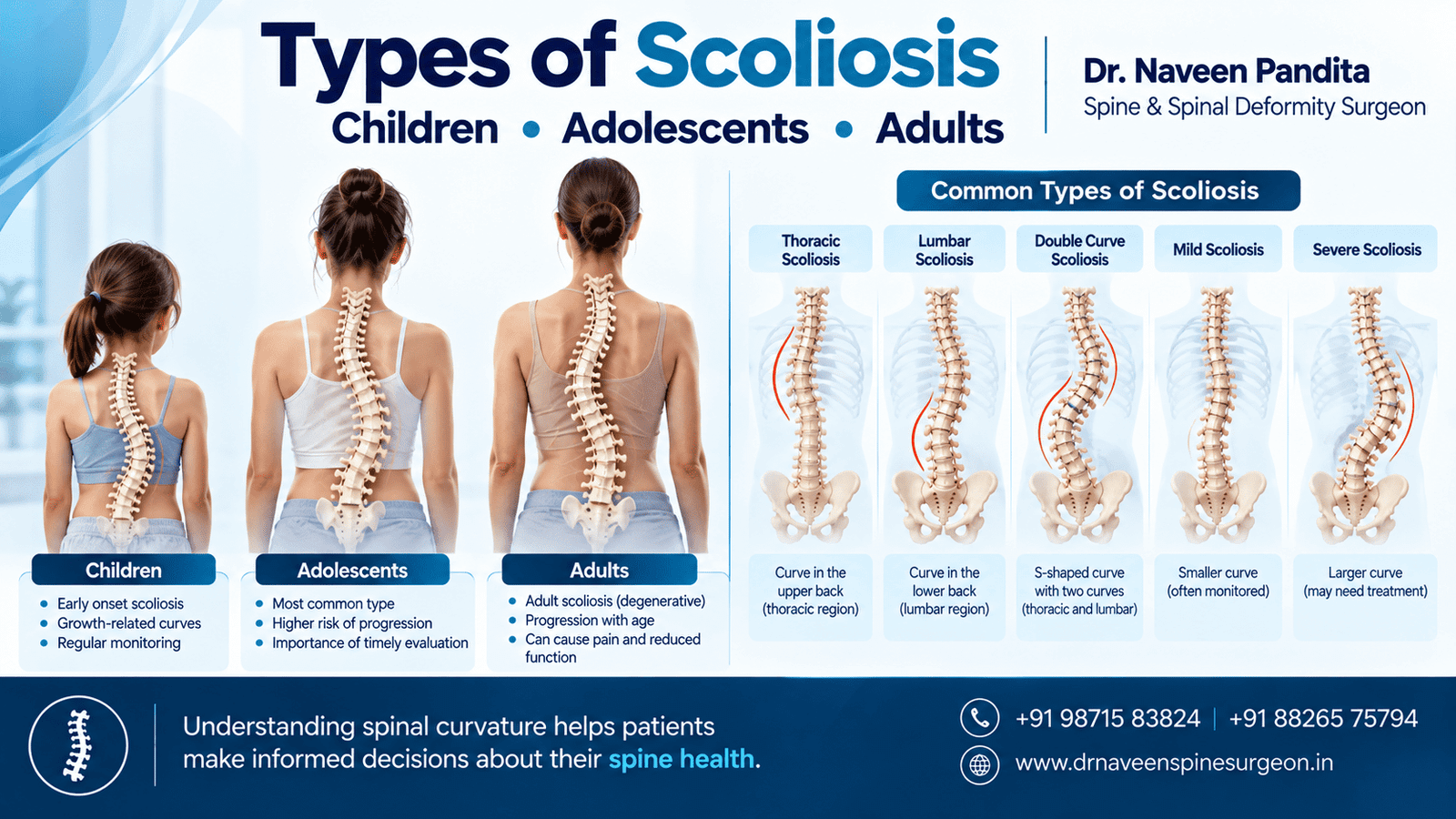
- Idiopathic scoliosis: The most common type, with no single identifiable cause. It is described by age of onset, such as infantile, juvenile, and adolescent idiopathic scoliosis. Adolescent idiopathic scoliosis appears around the growth spurt, usually between 10 and 18 years.
- Congenital scoliosis: Caused by vertebrae that did not form or separate normally before birth. It is often detected in early childhood.
- Neuromuscular scoliosis: Associated with conditions such as cerebral palsy, muscular dystrophy, or spinal muscular atrophy.
- Degenerative (adult) scoliosis: Develops later in life as discs and joints wear unevenly, often with spinal stenosis.
- Adult scoliosis from adolescence: A curve present since the teenage years that continues to progress or becomes painful.
Symptoms and Early Warning Signs
In children, scoliosis is usually painless, so parents should look for visible changes:
- One shoulder or shoulder blade appearing higher or more prominent
- Uneven waistline or one hip sitting higher
- Head not centred over the pelvis
- A rib hump when the child bends forward
- Clothes hanging unevenly
Adults are more often present with back pain, leg pain or numbness, reduced walking tolerance, fatigue after standing and a gradual stoop or loss of height. Pain alone does not confirm scoliosis, but a visible asymmetry deserves a clinical check.
What Causes Scoliosis?
In most adolescents, the cause is not fully understood, though genetics seem to play a role, and scoliosis often runs in families. Other causes include vertebral malformations present from birth, nerve and muscle disorders, previous spinal surgery or radiation, and age-related degeneration. Heavy school bags, poor posture and sports do not cause structural scoliosis, which is worth telling anxious parents.
How Is Scoliosis Diagnosed?
Diagnosis begins with a clinical examination, including the forward bend test, a check of shoulder, trunk and pelvic balance,e and a neurological examination. The key investigations are:
- Standing full-spine X-rays to measure the Cobb angle and the balance of the spine
- Bending or traction X-rays to see how flexible the curve is
- MRI when there are neurological symptoms, an unusual curve pattern, early-onset scoliosis, or surgery is being planned
- CT scan in selected cases, particularly congenital deformities or revision surgery
- Skeletal maturity assessment in growing children, which helps predict progression
When Does Scoliosis Require Surgery?
Surgery is typically chosen when a curve is substantial and anticipated to grow, produces significant discomfort or nerve compression, impairs balance or breathing, or does not respond to non-surgical treatment. Every decision is tailored to the person.
In extensively growing adolescents, chest curves beyond the level of about 45 to 50 are often considered for surgery because they tend to progress even after growth has finished. Symptoms, spinal balance, contractions, and overall health generally guide the choice. Surgery is not always the most effective option recommended because the curve looks dramatic on X-ray, and a second opinion is cheap before any major surgery.
Non-Surgical Scoliosis Treatment Options
Most patients with scoliosis are managed without surgery. Options include:
- Observation: Small curves are monitored with periodic examinations and X-rays, especially in children who are still growing.
- Bracing: For skeletally immature adolescents with moderate curves, commonly in the 25 to 40-degree range, a brace aims to prevent further progression. It does not usually reverse an existing curve, and its benefit depends on consistent wear.
- Physiotherapy and scoliosis-specific exercises: These can improve core strength, posture and function. Evidence for correcting a curve is limited, but they help with symptoms.
- Pain management for adults: Medication, targeted physiotherapy, weight management, and image-guided injections may relieve symptoms. Injections treat pain and do not correct the curve.
Types of Scoliosis Correction Surgery
The goals of scoliosis correction surgery are to reduce the curve, restore balance, stop progression, and protect the nerves. Common approaches are:
- Posterior spinal fusion with instrumentation: The standard operation for most adolescent and many adult deformities.
- Anterior or lateral approaches: Sometimes combined with posterior surgery to release stiff curves or place interbody cages.
- Osteotomies: Controlled bone cuts that allow correction of rigid or severe deformities.
- Growth-friendly techniques: Used selectively in very young children, so that the spine can grow while the curve is controlled.
Posterior Spinal Fusion and Instrumentation
Through an incision along the back, the surgeon places pedicle screws in the vertebrae, connects them with contoured rods,s and gradually corrects the curve. Bone graft is laid along the prepared spine so that the vertebrae fuse into one solid segment over the following months. The rods hold the correction while fusion takes place. Fusion limits motion in the fused segments, but most patients adapt well to everyday activities.
Advanced Techniques for Complex Spinal Deformities
Rigid curves, adult degenerative deformity, severe kyphoscoliosis, and revision cases may need more advanced strategies, including:
- Smith-Petersen, pedicle subtraction, or vertebral column resection osteotomies
- Interbody fusion to restore lumbar curvature and support the spine
- Decompression of narrowed nerve canals
- Pelvic fixation in selected adult deformities
- Intraoperative spinal cord monitoring, navigation and minimally invasive spine surgery techniques where suitable
These procedures need meticulous planning and a team trained for them, as discussed below.
How Scoliosis Surgery Is Planned and Performed
Planning starts well before the operating day. It includes reviewing the full-length X-rays, MRI or CT, measuring spinal balance, deciding which levels to fuse, checking heart, lung, bone health and nutrition, and discussing expectations with the patient and family.
During surgery, patients are under general anaesthesia, and the nerves are monitored throughout. Operating time and blood loss depend on the complexity of the curve, and blood-conservation measures are used. After the operation, patients are mobilised early with pain control and physiotherapy support.
Benefits, Limitations and Risks
Benefits may include a straighter and better balanced spine, halted progression, relief from nerve-related symptoms and improved appearance and function.
Limitations: Surgery rarely produces a perfectly straight spine, fusion reduces some flexibility, and not every pain symptom resolves.
Risks, as with any major spinal surgery, include:
- Infection or wound problems
- Bleeding and blood transfusion
- Nerve injury, which is uncommon but serious
- Implant problems, or a failure of the bones to fuse (pseudarthrosis)
- Junctional problems above or below the fused segment over time
- Anaesthetic and general medical complications
- The possibility of revision surgery
The risks vary with age, curve type, bone quality and general health, and they should be discussed openly before consent.
Recovery, Rehabilitation and Return to Daily Activities
Recovery is gradual, and timelines below are general estimates, not guarantees:
- Hospital stay: Often several days, depending on the procedure and the patient’s progress.
- First weeks: Walking is encouraged. Bending, lifting,g and twisting are restricted.
- School or desk work: Many adolescents return within a few weeks to a couple of months.
- Physical activity: Light activity increases progressively. Contact sports and heavy lifting usually wait several months, until fusion is sufficiently advanced.
- Long term: Fusion matures over many months. Follow-up visits with X-rays track healing.
Adults, particularly those undergoing larger reconstructions, often need a longer recovery and structured rehabilitation.
Scoliosis Surgery Cost in Noida
The cost of scoliosis surgery in Noida varies widely, so a single figure would be misleading. It depends on:
- The number of spinal levels fused and the complexity of the deformity
- Type and number of implants and any special equipment such as navigation or neuromonitoring
- Hospital, room category and length of stay
- Need for ICU care, blood products or additional procedures
- Insurance coverage, pre-authorisation and TPA policies
- Rehabilitation and follow-up needs
An accurate estimate is possible only after clinical evaluation and imaging. Patients can request a written estimate from the hospital’s billing team and ask what it includes and excludes.
Scoliosis Treatment for Adults and Adolescents
|
Feature |
Adolescent scoliosis |
Adult scoliosis |
|
Typical cause |
Idiopathic |
Degenerative or progression of an earlier curve |
|
Main symptom |
Visible asymmetry, usually painless |
Back or leg pain, stenosis, imbalance |
|
Main concern |
Preventing progression during growth |
Pain, function and spinal balance |
|
Non-surgical care |
Observation, bracing |
Physiotherapy, medication, injections |
|
Surgery goal |
Correct and stabilise the curve |
Decompress nerves, restore balance, relieve pain |
Adult scoliosis treatment is not simply a larger version of the adolescent operation. Bone quality, other medical conditions and the overall alignment of the spine and pelvis all shape the plan.
Scoliosis vs Kyphosis
Scoliosis is a sideways curve of the spine with rotation, whereas kyphosis is an excessive forward rounding of the upper back as seen from the side. They can occur together, called kyphoscoliosis.
|
Feature |
Scoliosis |
Kyphosis |
|
Direction of curve |
Sideways (coronal plane) |
Forward rounding (sagittal plane) |
|
Typical appearance |
Uneven shoulders or waist |
Rounded or hunched upper back |
|
Common causes |
Idiopathic, congenital, degenerative |
Postural, Scheuermann’s disease, fractures, congenital |
|
Treatment |
Observation, bracing, surgery |
Physiotherapy, bracing in growing children, surgery for severe or painful cases |
Kyphosis treatment in children and adults follows similar principles: assess the cause and the curve, begin with non-surgical care where appropriate and reserve surgery for significant or progressive deformity.
Why Specialist Training and Experience Matter
Spinal deformity surgery differs from routine spine procedures. It involves three-dimensional correction near the spinal cord and major blood vessels, advanced instrumentation, osteotomies, and neuromonitoring. A patient searching for the best scoliosis surgeon in Noida should look beyond rankings and ask about subspecialty training, the volume of deformity cases, the hospital’s neuromonitoring and intensive care facilities, and the surgeon’s willingness to explain alternatives and risks. No surgeon can be objectively “best” for every patient, and the right choice rests on training, transparency, and fit.
Dr Naveen Pandita Approach to Scoliosis Treatment
Dr Naveen Pandita is a complex spine and spinal deformity surgeon. His training includes:
- Fellowship in complex spine and spinal deformity surgery at Queen’s Medical Centre, Nottingham, UK
- Neurospine fellowship at Cambridge University Hospitals, UK
- Spine deformity fellowship at National University Hospital, Singapore
He manages adolescent and adult scoliosis, complex spinal reconstruction and minimally invasive spine surgery. His approach begins with listening and detailed assessment. Where observation, bracing or rehabilitation are suitable, they are discussed first. Where surgery is appropriate, the plan, expected benefits, limitations, ns and risks are explained so that patients and families can decide with confidence. Patients who want a second opinion before surgery are welcome.
How to Book a Scoliosis Consultation in Noida
Consider a consultation if:
- You or your child has a newly diagnosed spinal curve
- A parent notices uneven shoulders, waist,t or a rib hump in a growing child
- An adult has progressive deformity, back pain, or leg symptoms
- You want a second opinion about recommended surgery
- You have a complex or previously operated deformity
Please bring all X-rays, MRI or CT scans and earlier medical records.
Dr Naveen Pandita
Noida Sports Injury Centre Clinic, D-74, Block D, Sector 26, Noida, Uttar Pradesh 201301
Also consulting at: Max Super Speciality Hospital, Vaishali, Ghaziabad
Phone: +91-9871583824
Frequently Asked Questions
When is scoliosis surgery necessary?
Surgery is considered when a curve is large (often beyond 45 to 50 degrees in growing adolescents), progressing, causing nerve symptoms or significant pain, or affecting balance or breathing. The decision depends on the individual, not on the Cobb angle alone.
What is the best age for scoliosis correction surgery?
There is no single best age. In adolescent idiopathic scoliosis, surgery is usually done in the teenage years once the curve is clearly significant. Adults may be operated on at any age if symptoms and fitness justify it.
Is scoliosis surgery safe?
It is a well-established procedure, but it is major surgery with real risks, including infection, bleeding, nerve injury, and implant problems. Risk depends on the curve, age,e and health, and a surgeon should discuss it openly with you.
Can scoliosis be corrected without surgery?
Observation, bracing, and exercises can help control progression and symptoms, but they do not generally straighten an established curve. Significant correction usually requires surgery.
How much does scoliosis surgery cost in Noida?
The cost varies with the levels fused, implants, hospital, stay, and insurance. A reliable figure needs examination and imaging, followed by a written estimate from the hospital.
How long does recovery take after scoliosis surgery?
Hospital stay is usually several days. Return to school or desk work often takes weeks to a few months, and strenuous activity takes longer. Timelines are estimates and vary between patients.
Can adults undergo scoliosis correction surgery?
Yes, when symptoms such as pain, nerve compression,n or imbalance significantly limit life and non-surgical care has not helped. Adult surgery needs careful assessment of bone quality and overall health.
What is the difference between scoliosis and kyphosis?
Scoliosis is a sideways, rotational curve. Kyphosis is a forward rounding of the upper back. Some patients have both.
Can scoliosis worsen after skeletal maturity?
Yes. Larger curves, especially thoracic curves beyond about 50 degrees, may continue to progress slowly in adulthood, and degenerative changes can cause new curves. Regular follow-up is advised.
How do I find an appropriately qualified scoliosis surgeon in Noida?
Look for subspecialty spinal deformity training, regular experience with complex curves, access to neuromonitoring and intensive care, re and a surgeon who explains non-surgical options and risks clearly. A second opinion is reasonable.