
Lumbar Canal Stenosis Treatment in Noida: Causes, Symptoms and Treatment Options
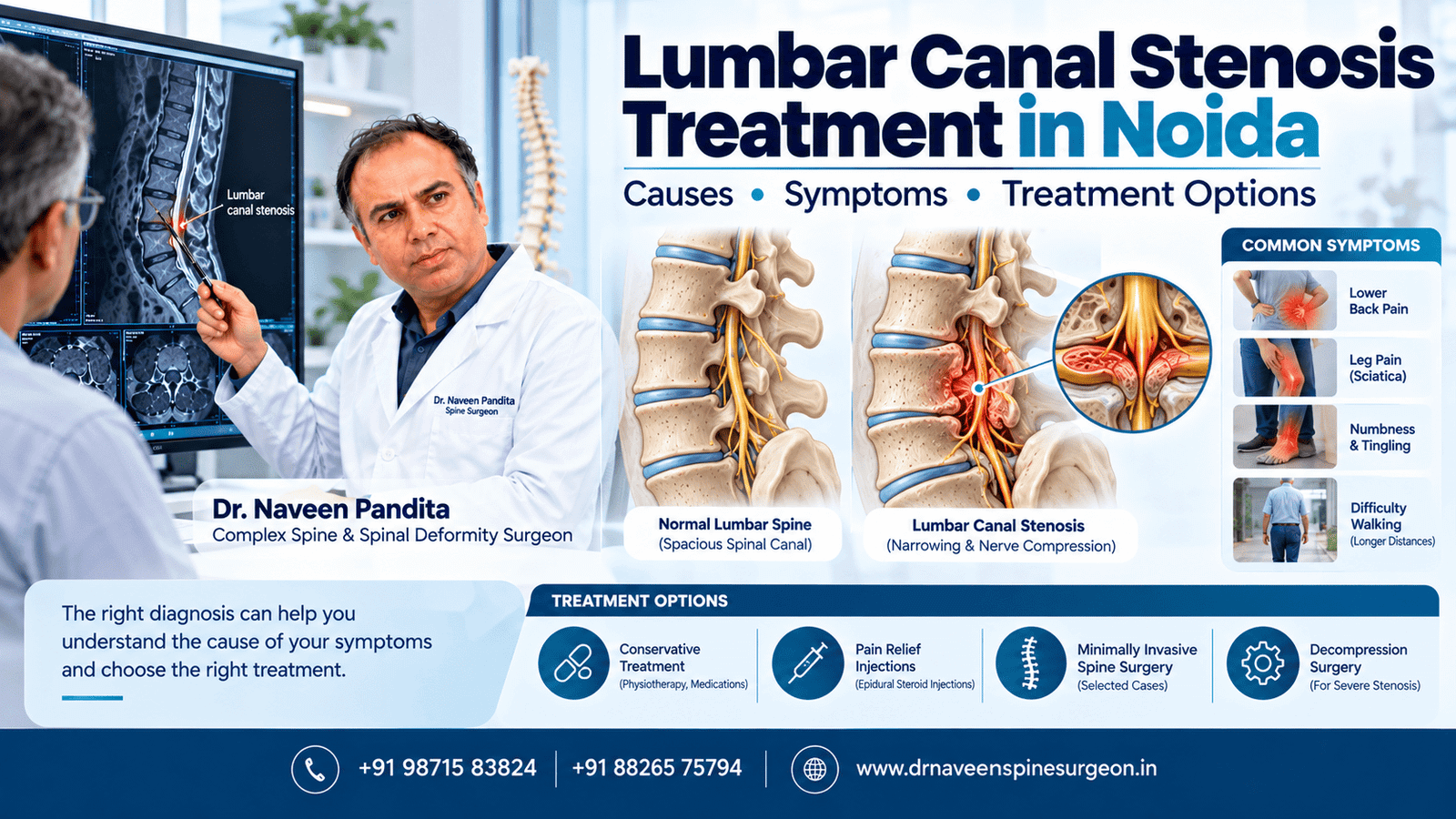
If you struggle to walk even short distances because of leg heaviness or back pain, you may be dealing with lumbar canal stenosis. This condition develops when the space around the nerves in the lower spine becomes narrow. It is common after the age of 50, and most patients improve with the right combination of care.
People searching for lumbar canal stenosis treatment in Noida often want two things: a clear diagnosis and an honest opinion on whether surgery is needed. Both require evaluation by an experienced spine specialist. Dr Naveen Pandita, Complex Spine & Spinal Deformity Surgeon, sees patients with lumbar spinal disorders at Noida Sports Injury Centre Clinic in Sector 26, Noida.
What Is Lumbar Canal Stenosis?
The spinal canal is a bony channel that protects the spinal cord and nerve roots. In the lower back (lumbar spine), the cord has ended, and a bundle of nerves, called the cauda equina, passes through the canal. When the canal narrows, these nerves can become compressed or irritated.
Lumbar canal stenosis is often called lumbar spinal stenosis, and the two terms are generally used interchangeably.
Common Causes
Most cases are degenerative, meaning they result from wear and tear over the years. Typical contributors include:
- Disc degeneration: discs lose height and may bulge into the canal.
- Facet joint enlargement: arthritic joints grow bony overgrowths that reduce space.
- Ligament thickening: the ligamentum flavum can thicken and buckle inward.
- Spondylolisthesis: one vertebra slips forward over another, narrowing the canal.
Some people are also born with a naturally narrow canal, so symptoms may appear earlier. Previous spine injury or surgery can occasionally play a role.
Symptoms of Lumbar Canal Stenosis
Symptoms usually build gradually. Many patients first notice that they cannot walk as far as they used to.
Common symptoms include:
- Lower back pain or stiffness
- Pain in one or both legs, sometimes extending to the calf or foot
- Numbness or tingling
- Heaviness or tiredness in the legs
- Weakness or a feeling that the legs may give way
When Should You See a Spine Specialist?
Consult a spine specialist if back or leg symptoms last more than a few weeks, keep returning, limit your walking, or disturb sleep and daily activities. Early assessment helps you avoid unnecessary delay and guides you toward the simplest effective treatment.
Urgent Warning Signs
Most stenosis is slow-moving and not an emergency. However, seek immediate medical care if you notice:
- Leg weakness rapidly worsens.
- New trouble regulating pee or faces, or inability to pass urine.
- Numbness in the saddle (groin, genitals, inner thighs).
- Rapid, severe neurological decline.
These may indicate serious nerve compression that needs urgent treatment.
How Is Lumbar Canal Stenosis Diagnosed?
A comprehensive discussion about your symptoms, walking tolerance, and medical history is followed by a physical and neurological evaluation to confirm the diagnosis. The doctor will evaluate your strength, reflexes, sensation, and walking pattern.
Investigations commonly include:
- MRI of the lumbar spine: the most useful test, showing nerves, discs, and the degree of canal narrowing.
- X-rays: assess alignment and slippage, sometimes with bending views to look for instability.
- CT scan: helpful when bone detail is needed, or when MRI is not suitable.
- Other tests: nerve conduction studies or vascular assessment when the diagnosis is unclear.
Scan findings must match your symptoms. Many people over 50 have narrowing on MRI without any complaints, so treatment decisions depend on the whole clinical picture, not the report alone.
Lumbar Canal Stenosis Treatment in Noida
Treatment is stepwise. Most patients begin with non-surgical care, and surgery is reserved for those who need it.
Non-Surgical Treatment
Conservative care helps many patients, particularly those with mild to moderate symptoms. It may include:
- Activity modification: avoiding positions that trigger symptoms while staying active.
- Physiotherapy: core strengthening, flexibility work and walking programmes, often with forward-flexed exercises such as stationary cycling.
- Medications: pain relievers or nerve-pain medicines, used as prescribed and with attention to kidney, stomach and heart health.
- Weight management: reducing load on the lumbar spine.
- Epidural or nerve-root injections: selected patients may benefit from image-guided injections to settle inflammation. These can offer temporary relief and help to clarify the pain source, but they do not remove the narrowing.
When Is Lumbar Stenosis Surgery Required?
Surgery may be considered when:
- Symptoms persist despite an appropriate period of conservative treatment
- Walking distance is significantly reduced, and quality of life suffers
- Leg weakness or other neurological deficits develop or progress
- MRI findings clearly correlate with your symptoms
Not everyone with stenosis needs an operation. The decision is made together with the patient after weighing symptoms, scans, age, and overall health.
Surgical Options for Lumbar Stenosis
The goal of surgery is to create more room for the nerves. The approach depends on the pattern of stenosis.
- Lumbar decompression surgery: removes the tissue pressing on the nerves, such as thickened ligament and overgrown bone.
- Lumbar laminectomy: removes part or all of the lamina, the bony roof of the canal, to relieve pressure. It is a well-established procedure for lumbar stenosis.
- Minimally invasive decompression: uses smaller incisions and specialised retractors or tubular systems to preserve muscle and normal structures where anatomy allows. It is suitable for selected patients, not everyone.
- Decompression with fusion: when there is instability, spondylolisthesis, or deformity, joining the vertebrae with screws and rods may be advised alongside decompression, so that the spine remains stable.
Each option has its own benefits and risks, which should be discussed in detail before any decision.
Why Choose Dr. Naveen Pandita for Lumbar Canal Stenosis Treatment in Noida?
Choosing a spine surgeon is a personal decision, and it should rest on training, clarity, and trust rather than advertising claims.
Dr Naveen Pandita specialises in complex spine surgery and spinal deformities. This history is critical for lumbar stenosis because many patients have coexisting disorders such as spondylolisthesis, scoliosis, or degenerative deformity that necessitate cautious planning.
What patients can expect:
- Individualised assessment: treatment is based on your symptoms, scans, and daily needs, not a fixed protocol.
- A stepwise approach: from conservative management to advanced surgical options only when indicated.
- Minimally invasive spine surgery: offered where it is appropriate for the condition.
- Clear discussion: benefits, limitations, and risks explained in plain language.
Consultations are held at Noida Sports Injury Centre Clinic – Dr Naveen Pandita, Sector 26, Noida, Uttar Pradesh. The clinic is convenient for patients from Sector 18, Sector 20, Sector 24, and Sector 25, as well as Greater Noida and nearby Delhi NCR. If you are searching for a spine surgeon near me for lumbar stenosis, a first consultation will help you understand your options.
Lumbar Canal Stenosis Surgery Cost in Noida
The cost of surgery cannot be fixed without examining the patient. A responsible estimate depends on:
- Number of spinal levels involved
- Type of procedure, whether decompression alone or decompression with fusion
- Implants, if needed
- Hospital and room category, and length of stay
- Pre-operative investigations
- Other medical conditions that need additional care
- Insurance coverage or cashless approval
Because of these variables, any quoted figure without an assessment may be misleading. After your evaluation, ask for an itemised estimate, check what your insurer covers, and clarify what is included in the package.
Recovery After Lumbar Stenosis Surgery
Recovery varies from person to person. It depends on the procedure performed, your age, the severity and duration of nerve compression, your general health, and how closely you follow rehabilitation.
In general:
- Many patients are urged to walk within a day of their surgery.
- The hospital stay for decompression is typically brief, but may be longer after fusion.
- Leg discomfort usually recovers faster than numbness, which can take weeks to months to relieve and sometimes does not.
- Physiotherapy, moderate activity, and avoiding heavy lifting or rapid twisting in the early stages all aid in healing.
- Fusion requires a longer restricted-activity period than decompression alone.
Your surgeon will give instructions specific to your operation and warning signs to report, such as fever, wound discharge, or new weakness.
Frequently Asked Questions
What is the best treatment for lumbar canal stenosis?
There is no single best treatment for everyone. Mild to moderate cases often respond to physiotherapy, medication and activity changes. Surgery helps when symptoms are disabling, or nerves are at risk.
Can lumbar stenosis be treated without surgery?
Yes, in many cases. Exercise, weight control, medicines, and selected injections can reduce symptoms. The narrowing itself does not reverse, but symptoms can become manageable.
When does lumbar stenosis require surgery?
Surgery is considered when conservative care has not worked, walking is severely limited, or weakness develops. Bladder or bowel changes and rapid weakness need urgent attention.
Is lumbar laminectomy safe?
It is a commonly performed procedure with good outcomes in appropriately selected patients. Like any surgery, it carries risks such as infection, bleeding, nerve injury, dural tear,r and the possibility of incomplete relief. Your surgeon should explain these in the context of your health.
How much does lumbar stenosis surgery cost in Noida?
Cost depends on levels treated, procedure type, implants, hospital stay, ay and your medical profile. A reliable estimate is possible only after consultation and review of your MRI.
How long does recovery take after lumbar stenosis surgery?
Early walking is usually encouraged, and many people resume light activity in a few weeks. Full recovery can take several months, longer after fusion.
Can lumbar stenosis come back after surgery?
Symptoms can recur, either from narrowing at the same level or from degeneration at an adjacent level. Staying active, maintaining a healthy weight, and attending follow-ups lower this risk but cannot remove it.
Conclusion
Lumbar canal stenosis is common and frequently treatable. The most crucial stage is a precise diagnosis that connects your symptoms to your MRI, followed by treatment tailored to your specific needs. Many people perform well without surgery, but others benefit from decompression or stabilisation when the need is evident.
If leg discomfort, numbness, or impaired walking ability are interfering with your life, see Dr Naveen Pandita at Noida Sports Injury Centre Clinic, Sector 26, for lumbar canal stenosis therapy in Noida. Bring your MRI, X-rays, and previous results to ensure that your alternatives are explained openly and without pressure.
Schedule a consultation with Dr Naveen Pandita to discuss your case and treatment options