Non-Surgical Back Pain Treatment in Noida: What Works Before Surgery?
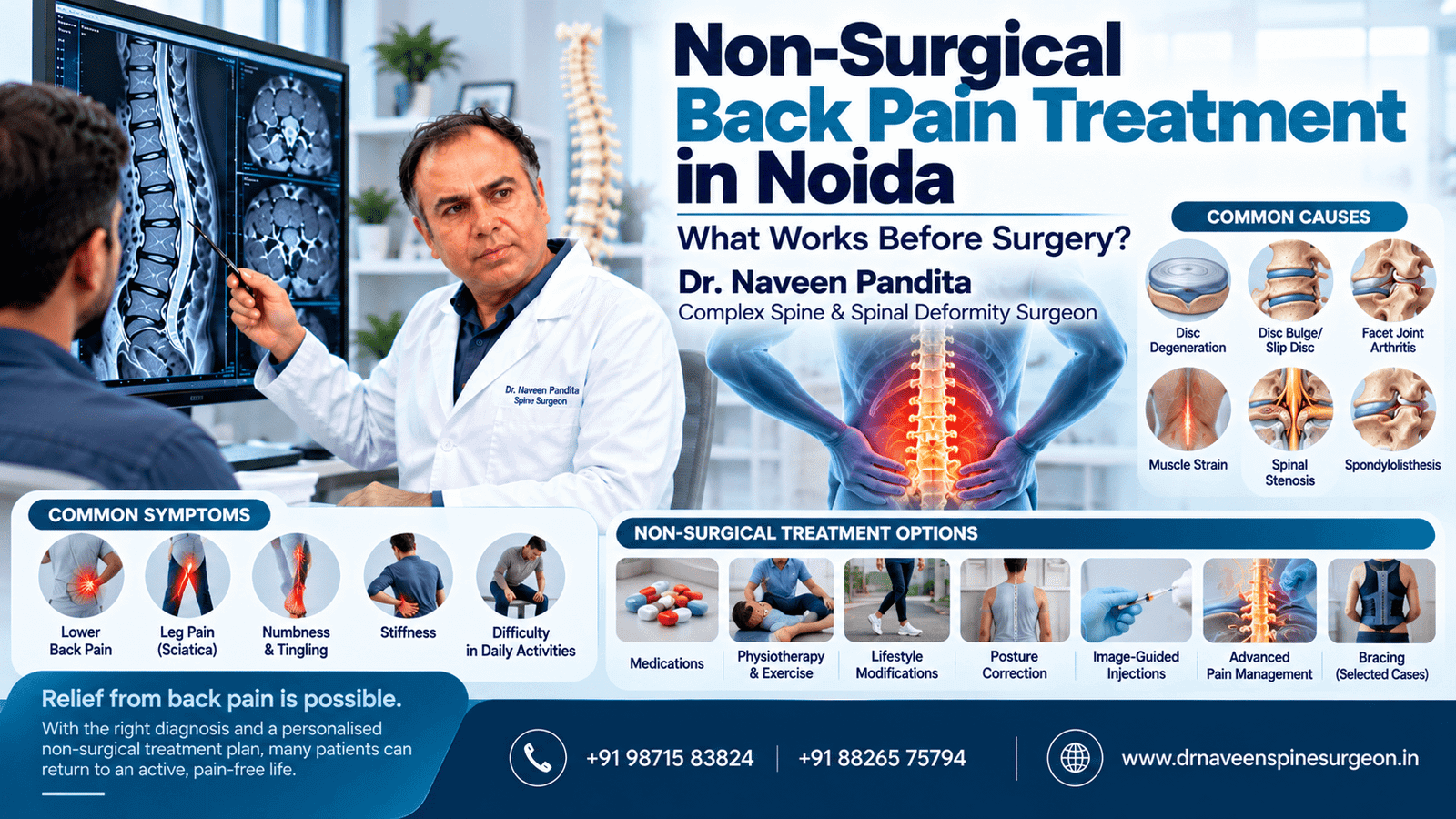
Short answer: Yes, many cases of lower back pain, disc-related pain, and sciatica can be managed without surgery at first. Whether that is appropriate for you depends on the cause of the pain, your neurological examination, how severe your symptoms are, and how you respond to treatment over time.
If you are searching for non-surgical back pain treatment in Noida, you are probably worried about an MRI report, pain that radiates down your leg, or a doctor’s mention of the word “surgery”. This guide explains what conservative care involves, which treatments have reasonable evidence behind them, and which warning signs mean you should not wait. The team, led by Dr Naveen Pandita, Principal Consultant – Spine Surgery & Spinal Deformity at Max Super Speciality Hospital, Vaishali, Ghaziabad, also consults at the Noida Sports Injury Centre Clinic in Sector 26, Noida.
What Is Non-Surgical Back Pain Treatment?
Non-surgical (conservative) treatment means managing back pain without an operation. It usually combines staying active, a structured exercise programme, short-term medicines when needed, simple symptom-relief measures and education about posture and daily activity. In selected patients, image-guided injections may also be considered.
Conservative care is most appropriate when:
- The pain is mechanical, meaning related to muscles, ligaments, joints, or discs and often changing with movement or posture.
- There is no significant or worsening nerve weakness.
- No red-flag features are pointing to a serious cause.
It is not appropriate as the only approach when pain is caused by a fracture, infection, tumour or severe nerve compression. These conditions need prompt, specific assessment. This is why a proper diagnosis comes before any treatment plan.
Can Back Pain Be Treated Without Surgery?
Most back pain can be treated without surgery. Acute lower back pain often improves substantially within a few weeks with activity, exercise,e and basic pain relief. Disc-related leg pain (sciatica) also improves with non-surgical care in many people, although recovery can take longer. A small proportion of patients need surgery, usually because of persistent disabling symptoms, clear nerve compression that matches their symptoms, or a serious structural problem.
An abnormal MRI does not automatically mean an operation. Disc bulges, degeneration, and age-related changes are common in people with no pain at all, so scan findings must always be matched with your symptoms and physical examination.
Which Non-Surgical Back Pain Treatments Actually Work?
Staying active and modifying painful activities
Most back pain patients are no longer encouraged to spend extended periods of time in bed. In general, gentle walking and gradually returning to normal activities are more beneficial to recuperation than full rest. This does not mean that you should “push through” acute pain. It entails avoiding movements that exacerbate your symptoms, such as heavy lifting or extended forward bending, while keeping your body moving. Limitation: If nerve pain is severe, activity alone may not be adequate. If your symptoms intensify or do not go away, see a doctor.
Individualised physiotherapy and progressive exercise
Exercise-based rehabilitation is one of the most well-supported treatments for chronic and recurrent low back pain. Good back pain physiotherapy in Noida should be individualised to your diagnosis rather than a set regimen for everyone. It may include core and hip strengthening, mobility exercises, walking programs, and lifting and posture advice. Limitation: Results are dependent on consistency and adequate dose, and particular disc or stenosis presentations may necessitate avoiding specific movements. If you experience leg symptoms, get an evaluation before starting.
Appropriate pain-relief medicines under medical guidance
Short courses of simple analgesics, anti-inflammatory medicines or muscle relaxants may help you stay mobile and take part in rehabilitation. Medicines for nerve-related pain are sometimes used in selected patients. Limitations: medicines relieve symptoms rather than fix the underlying problem, and they carry risks, especially for people with kidney, stomach, heart or liver conditions, or those on other medication. Do not self-medicate for weeks or rely on repeated over-the-counter painkillers. Review with a doctor if you need them regularly.
Heat and other simple symptom-relief measures
Local heat, short rests in a comfortable position and gentle movement can ease muscle spasm for many people. Limitation: these measures give temporary comfort and do not treat a disc or nerve problem. New numbness, weakness or fever means you need assessment rather than home care.
Education, ergonomics and gradual return to normal activity
Understanding that most back pain is not harmful, and that mobility is typically safe, decreases fear and speeds up recovery. Practical approaches include modifying your workstation, taking regular movement breaks from sitting, learning safer lifting techniques, and gradually increasing your participation in work, exercise, or sports. Limitation: Ergonomic adjustments help with rehabilitation and prevention, but they are not a treatment for structural nerve compression.
Selected image-guided injections for appropriate patients
For some patients with significant leg pain from nerve irritation, an image-guided epidural or nerve-root injection may be considered. These can provide short- to medium-term relief that makes rehabilitation easier. Limitations: the benefit is not guaranteed, may not last, and does not remove the underlying disc problem. Injections have risks and are suitable only after proper clinical and imaging assessment.
Other specialist-directed treatments when clinically indicated
Depending on the diagnosis, a professional may recommend temporary bracing, therapy for an underlying problem like osteoporosis, or other targeted solutions. Massage, traction, manipulation, vitamins, and proprietary “techniques” are examples of passive treatments that are not always beneficial, and the evidence for some of them is poor. If you are considering any of these, speak with a skilled doctor first, especially if you suffer leg weakness or numbness.
Non-Surgical Treatment for an L4-L5 Disc Bulge
The lumbar spine is made up of five vertebrae (L1 through L5). Disc issues are most common at the L4-L5 level, as well as L5-S1, because these levels bear a substantial portion of the bending and lifting load. A disc bulge, also known as a herniation, happens when the disc’s soft inner material pushes against or through its outer layer, potentially irritating a surrounding nerve.
Can a bulging L4-L5 disc be managed non-surgically? Yes, it happens frequently. Many people are treated with activity adjustment, physiotherapy, medications, and, on occasion, an injection if they have discomfort but no severe weakness. Disc herniations can shrink with time, and symptoms often resolve even when the MRI shows some abnormality.
What matters is the match between your MRI and your symptoms:
- A bulge that doesn’t correspond with your pain pattern or examination may not be the true source of your problem.
- A large herniation compressing a nerve that explains your leg pain, numbness, or weakness needs closer specialist attention.
If you are looking for a spine specialist for a disc bulge in Noida, bring your MRI films and report to the consultation. A Dr Naveen Pandita Spine specialist can interpret the images alongside your examination instead of relying on the report alone.
Slip Disc and Sciatica Treatment in Noida Without Surgery
“Slip disc” is a popular term for disc herniation. Sciatica is pain, often with tingling or numbness, that travels from the lower back or buttock down the leg. It typically happens because a nerve root is irritated or compressed, most commonly by a disc herniation or by narrowing of the spinal canal or nerve exits (lumbar spinal stenosis).
Can sciatica be treated without surgery? In most patients, yes, at least initially. A typical approach includes staying active within comfort, a graded exercise programme, short-term medicines, and in selected patients an image-guided injection to calm severe nerve pain. Many people improve over weeks to a few months.
Please see a spine specialist promptly, without waiting for long periods of home treatment, if you have:
- Leg weakness, a foot that drags or “slaps”, or difficulty standing on your toes or heels.
- Numbness that is spreading or increasing.
- Leg pain that is severe and not controlled with simple measures.
- Pain that wakes you repeatedly from sleep or is steadily worsening.
How Long Does Non-Surgical Back Pain Treatment Take?
No one can promise a fixed recovery period, because it depends on the cause and the individual. As a general guide:
- Acute mechanical back pain: often improves noticeably over days to a few weeks.
- Sciatica from a disc problem: improvement often occurs over several weeks to a few months.
- Chronic or recurrent lower back pain: usually needs a longer period of rehabilitation, often with gradual rather than dramatic improvement, and a focus on long-term strength and activity habits.
Progress is not always linear. You may have good and bad days. If you are not improving as expected, or if symptoms are worsening, the plan should be reviewed instead of repeating the same treatment indefinitely.
When Is Surgery Necessary for Back Pain?
Surgery is not automatically needed after an MRI diagnosis or a short period of pain. It may be considered when:
- Disabling symptoms persist despite an appropriate trial of non-surgical treatment, usually over a period of weeks to months that your surgeon will discuss with you.
- Significant nerve compression on imaging clearly corresponds with your symptoms and examination findings.
- Neurological deficit such as meaningful weakness is present or progressing.
- Selected structural problems, such as certain cases of spinal instability, Spinal deformity, or severe stenosis, are causing symptoms.
Emergency warning signs: do not wait for a routine appointment
Go to the nearest emergency department immediately if back pain is accompanied by any of the following:
- New difficulty passing urine, inability to pass urine, or loss of bladder or bowel control
- Numbness in the saddle area (groin, genitals, buttocks or inner thighs)
- Severe or rapidly worsening weakness in one or both legs
These may indicate cauda equina syndrome, which is a surgical emergency. Also seek urgent medical advice for back pain after significant trauma, or with fever, unexplained weight loss, a history of cancer, or persistent night pain unrelated to movement.
Which Doctor Should You Consult for Back Pain in Noida?
Different professionals play different roles:
- General physician or family doctor: first assessment, safe medicines,s and referral.
- Physiotherapist: exercise-based rehabilitation and movement guidance.
- Orthopaedic specialist: assessment of bone, joint and spine problems.
- Neurosurgeon or spine surgeon: evaluation of nerve compression, neurological deficit, complex spine conditions and surgical decisions.
A spine specialist assessment is particularly useful if you have leg pain that persists, suspected nerve compression, abnormal findings such as weakness or numbness, or uncertainty about whether you need surgery.
Dr Naveen Pandita is Principal Consultant – Spine Surgery & Spinal Deformity at Max Super Speciality Hospital, Vaishali, Ghaziabad, and consults at the Noida Sports Injury Centre Clinic in Sector 26, Noida. When choosing any back pain specialist, it is reasonable to look at their qualifications and registration, their experience with your specific condition, whether they explain non-surgical options before surgery, and whether they examine you properly instead of relying only on scan reports.
Non-Surgical Back Pain Treatment in Noida Sector 26
Patients looking for a spine clinic near Noida Sector 26 can consult Dr Naveen Pandita at:
Noida Sports Injury Centre Clinic, D-74, Block D, Sector 26, Noida, Uttar Pradesh
The clinic is a useful resource for people in Sector 26 and surrounding areas. Patients looking for a spine clinic near Noida Sector 18 may want to consider travelling to Sector 26. The clinic is located in Sector 26, not Sector 18. Others who may find it accessible include people travelling from surrounding sectors in Noida and other regions of Delhi NCR, depending on their individual travel convenience.
A back pain consultation in Noida should typically include a discussion of your symptoms and history, a physical and neurological examination, review of any existing X-ray or MRI reports, and a plan that explains your options, including non-surgical care and when surgery would or would not be considered. Please bring previous reports, scans and a list of your medicines. To book an appointment, use the contact details on the official website.
Frequently Asked Questions
Can back pain be treated without surgery?
Yes. Most back pain, including many disc-related cases, improves with non-surgical care such as activity, exercise, appropriate medicines, and sometimes injections. Surgery is considered for a minority with persistent disabling symptoms, clear nerve compression, neurological deficit, or specific structural problems.
Can an L4-L5 disc bulge heal without surgery?
Many L4-L5 disc bulges become less painful with conservative treatment, and some herniations shrink over time. Whether it is suitable for you depends on your symptoms, examination and how severe the nerve involvement is.
Which doctor should I consult for an L4-L5 disc bulge?
Start with a doctor who can examine you and review your MRI. If you have persistent leg pain, numbness, weakness,s or are unsure about surgery, a spine surgeon or neurosurgeon is the appropriate specialist.
Can sciatica be treated without surgery?
Often, yes. Many people improve with a combination of staying active, structured exercise, short-term medicines and, in selected cases, image-guided injections. Progressive weakness or severe, unrelenting pain should be assessed promptly.
How long should I try conservative treatment before considering surgery?
There is no single time limit. Many guidelines consider surgery when disabling nerve pain persists after several weeks to months of appropriate treatment, but this varies. Urgent surgery may be needed sooner for progressive weakness or cauda equina symptoms.
When does back pain require urgent medical attention?
Seek emergency care for urinary retention or loss of bladder or bowel control, saddle-area numbness, or severe or rapidly worsening leg weakness. Get urgent advice also for back pain after major trauma, or with fever, unexplained weight loss, ss or a history of cancer.
Who is the best doctor for back pain in Noida?
There is no objective ranking, and the right doctor depends on your condition. Consider qualifications, registration, experience with your type of problem, a clear examination-based explanation, i on and willingness to discuss non-surgical options. Dr. Naveen Pandita, Principal Consultant – Spine Surgery & Spinal Deformity, is one option for consultation.
Where can I consult a spine specialist near Noida Sector 18?
Dr Naveen Pandita consults at the Noida Sports Injury Centre Clinic, D-74, Block D, Sector 26, Noida. It is not in Sector 18, but may be a practical option depending on your travel convenience.
Where can I seek back pain treatment in Noida Sector 26?
At the Noida Sports Injury Centre Clinic, D-74, Block D, Sector 26, Noida, where Dr. Naveen Pandita consults. Whether it suits you depends on your needs and accessibility.
How do I know whether I need a spine surgeon or physiotherapy?
Physiotherapy is often a sensible first step for mechanical back pain without red flags. A spine surgeon assessment is useful if you have persistent leg pain, numbness or weakness, a large disc herniation or stenosis on MRI, or are being advised surgery and want clarity.
Conclusion
Non-surgical back pain therapy in Noida typically begins with a correct diagnosis and progresses to exercise, rehabilitation, appropriate medications, and, in some cases, targeted injections. The majority of patients do not require surgery; however, early intervention is critical when nerve compression, paralysis, or emergency warning signals provide.
If you are experiencing persistent back pain, disc-related symptoms, or sciatica, you can consult Dr Naveen Pandita at the Noida Sports Injury Centre Clinic, D-74, Block D, Sector 26, Noida. Patients’ outcomes differ, and no treatment can guarantee success for everyone.
Medical disclaimer: This article is for general education only and is not a substitute for personal medical advice, diagnosis or treatment. In an emergency, go to the nearest hospital.