
Spinal Stenosis Treatment: Symptoms, Causes and Treatment Options
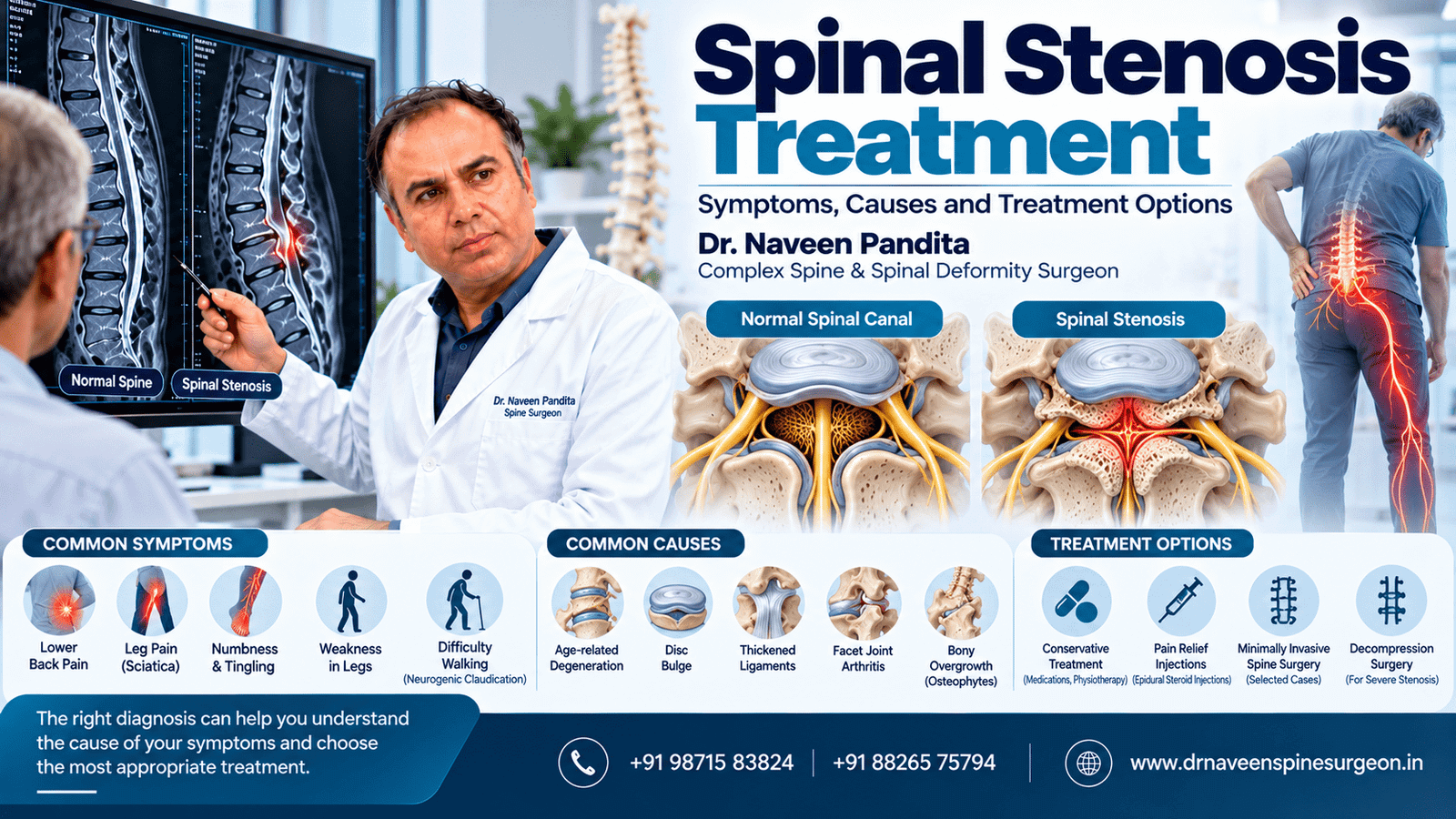
Spinal stenosis treatment ranges from physiotherapy, exercises, and medicines to decompression surgery, and the right choice depends on which nerves are affected, how severe the symptoms are, and how much they limit daily life. Most people with mild to moderate symptoms are first managed without surgery. Surgery is considered when symptoms stay disabling despite proper non-surgical care, or when there are signs of progressive nerve or spinal cord compression. This guide explains the symptoms, causes, diagnosis,s and each treatment option in plain language, so you can decide when and whom to consult.
What Is Spinal Stenosis?
Spinal stenosis is a narrowing of the spinal canal or of the small openings (foramina) through which nerves leave the spine. The narrowing leaves less room for the spinal cord or nerve roots, which can become irritated or compressed.
Symptoms vary because they depend on where the narrowing is, how tight it is, and which nerves are affected. Two people with similar scans can feel very different, and some have no symptoms at all.
What Are the Symptoms of Spinal Stenosis?
Common symptoms include:
- Back pain or neck pain
- Pain spreading into the arms or legs
- Numbness, tingling, or a heavy, weak feeling in the limbs
- Difficulty standing or walking for long, often easing on sitting or bending forward
In the lower back (lumbar region), symptoms mainly affect the buttocks and legs. In the neck (cervical region), they may affect the shoulders, arms and hands, and sometimes the legs and balance as well.
Neurogenic claudication is leg pain, heaviness,s or weakness that appears with standing or walking and eases with sitting or leaning forward. It is typical of lumbar stenosis.
Seek immediate medical evaluation for any of these emergency warning signs:
- New difficulty passing urine, or loss of bladder or bowel control
- Numbness in the saddle area (groin, genitals, inner thighs)
- Rapidly worsening weakness in a leg or arm
- Rapidly worsening balance, walking or hand function, which may suggest spinal cord compression in the neck
What Causes Spinal Stenosis?
Most cases result from age-related wear and tear. Common contributors are:
- Disc degeneration, where discs lose height and bulge into the canal
- Thickened spinal ligaments
- Facet joint arthritis and bone spurs (osteophytes)
- Spondylolisthesis, where one vertebra slips over another
- A naturally narrow canal from birth (congenital narrowing)
- Less commonly, injury, tumours or infection
Imaging changes do not always cause symptoms. Many people have narrowing on MRI with little or no discomfort, which is why scan findings must be matched with symptoms and examination.
How Is Spinal Stenosis Diagnosed?
Your symptoms, a neurological exam, and imaging all contribute to a diagnosis. An MRI report isn’t enough.
Prior to assessing strength, sensation, reflexes, and gait, the doctor inquires about walking distance, posture alleviation, urine habits, and balance. An MRI is best used to visualise the nerves and discs. CT scans are good for evaluating bone detail, whereas X-rays (especially bending views) can indicate instability. Nerve conduction studies are sometimes performed when the cause of symptoms is unknown.
What Is the Best Treatment for Spinal Stenosis?
There is no single best treatment. The right choice depends on symptom severity, the spinal region involved, neurological findings, functional limits and your overall health.
Non-Surgical Spinal Stenosis Treatment
Most people start here. Options include:
- Physiotherapy and individualised exercises to improve core strength, flexibility and walking tolerance
- Activity modification, such as pacing walks and using forward-leaning support
- Pain-relief and nerve-pain medicines prescribed by a clinician
- Selected epidural or nerve-root injections where clinically appropriate
These measures can reduce pain and improve function, and many people do well with them. They do not reverse the anatomical narrowing, and relief from injections is often temporary.
When Is Spinal Stenosis Surgery Needed?
Surgery may be considered when:
- Disabling symptoms persist despite an adequate trial of non-surgical care
- Imaging shows significant nerve compression that matches the symptoms
- Limb weakness is progressing
- The spinal cord is compressed, particularly in the neck
Most surgery is elective, so you have time to weigh your options. Urgent assessment is needed for the emergency signs listed above. An MRI showing stenosis is not, by itself, a reason to operate.
Types of Spinal Stenosis Surgery
- Decompression: removal of tissue that is pushing on nerves and is the primary goal of surgery.
- Laminectomy or laminotomy: the removal of all or part of the lamina (the canal’s ceiling) to make space.
- Foraminotomy: process of enlarging the orifice through which a nerve leaves.
- Spinal fusion: uniting of vertebrae with screws and rods, which is considered when there is instability, substantial slippage, or deformities.
Minimally invasive and endoscopic techniques use smaller incisions and may reduce tissue disturbance and hospital stay. They are not suitable for every patient or every pattern of stenosis, and the surgeon’s assessment of the individual case decides the approach. All surgery carries risks, including infection, bleeding, nerve injury, incomplete relief,f and recurrence of narrowing.
Lumbar Spinal Stenosis With Neurogenic Claudication
Spinal stenosis in the lumbar region with neurogenic claudication causes leg pain, tingling or heaviness after standing or walking a short distance. Sitting, bending forward or leaning on a shopping trolley usually brings relief, because flexing the spine opens the canal slightly.
Lumbar spinal stenosis treatment normally begins with physiotherapy, medicines and activity pacing, with injections for selected patients. If walking remains badly limited, decompression surgery is the usual next step, with fusion added only when the spine is unstable.
Cervical Spinal Stenosis: When Is It Serious?
Cervical spinal stenosis is a neck narrowing problem. It may irritate a nerve root, resulting in neck and arm pain, tingling, numbness, or weakness. When it compresses the spinal cord, it develops a hazardous condition called cervical myelopathy.
Clumsy hands (difficulties with buttons, writing, or phone use), unsteady walking, poor balance, and progressive weakness or stiffness in the limbs are all warning signs of myelopathy. Suspected spinal cord dysfunction needs a quick professional evaluation because lost function may not fully recover if compression persists.
Is Spinal Stenosis Permanent? Can It Be Cured?
The structural narrowing is usually permanent due to degenerative change, but the symptoms it causes can often be managed. Exercise, medications, injections, and surgery can all help to lessen discomfort and improve walking, even if the canal remains small without surgery.
Surgery expands the space around the nerves, which helps reduce symptoms in many individuals. It cannot stop the aging of the other spinal segments, and symptoms or narrowing may reappear over time. For these reasons, the term “cure” is not a true promise. The realistic goal is to improve function and reduce discomfort, with the best results occurring when nerve compression is addressed before long-term damage occurs.
How Much Does Spinal Stenosis Treatment Cost in India?
Cost varies widely, so no single figure is reliable. The main factors are:
- Type of treatment: physiotherapy, injections or surgery
- Investigations such as MRI, CT and blood tests
- Surgical complexity and number of spinal levels treated
- Implants, if fusion is needed
- Hospital category, room type and length of stay
- Rehabilitation and follow-up
Ask the hospital for a written, itemised estimate after your examination and scans, and check what your insurance covers.
Why Consult a Spine Specialist for Spinal Stenosis?
A specialist can tell whether your symptoms truly match the scan, whether conservative care is still reasonable, and whether more tests or surgery are justified. That judgement matters, because the best plan is often not an operation.
Dr Naveen Pandita is Principal Consultant, Spine Surgery and Spinal Deformity, at Max Super Speciality Hospital, Vaishali. His areas of interest include complex spine surgery, spinal deformity, minimally invasive spine surgery and endoscopic spine surgery. Patients looking for a spine surgeon in Noida, Ghaziabad, Vaishali or the wider Delhi NCR can consult him at:
- Max Super Speciality Hospital, Vaishali
- Pushpanjali Medical Centre, Karkardooma, Delhi
- Noida Sports Injury Centre Clinic, Sector 26, Noida
If back, neck or limb symptoms are persisting or limiting your walking, you are welcome to arrange a consultation to discuss your options. Anyone with the emergency signs above should go to the nearest emergency department without waiting for an appointment.
Frequently Asked Questions About Spinal Stenosis Treatment
What is the best treatment for spinal stenosis?
The best treatment is the one matched to your symptoms, scan findings, and health. Most people begin with exercise, physiotherapy, and medicines; surgery is reserved for disabling or progressive nerve compression.
Can spinal stenosis be treated without surgery?
Yes, in many cases. Physiotherapy, exercises, activity changes, medicines, and selected injections can control symptoms, although they do not widen the canal.
Is spinal stenosis permanent?
The narrowing from degeneration usually persists, but symptoms often improve with treatment. Surgery can relieve pressure on nerves without guaranteeing a permanent cure.
Can spinal stenosis cause paralysis?
Severe, untreated compression of the spinal cord or nerves can cause lasting weakness, and rarely paralysis. This is uncommon, and warning signs such as progressive weakness or loss of bladder control need urgent assessment.
Which exercises are helpful for spinal stenosis?
Gentle walking, stationary cycling, core strengthening,g and flexion-based stretches are commonly advised for lumbar stenosis. Exercises should be individualised by a physiotherapist, especially with neck symptoms.
When does spinal stenosis require surgery?
Surgery is considered when symptoms remain disabling despite proper non-surgical care, when weakness is progressing, or when the spinal cord is compressed.
How long does recovery from spinal stenosis surgery take?
Recovery varies with the procedure and the person. Many patients walk within a day or two and return to light activity in a few weeks, while fusion usually needs longer. Your surgeon will give a personal timeline.
Is minimally invasive surgery suitable for spinal stenosis?
It can be, for selected patients with suitable anatomy, and may mean smaller incisions and quicker early recovery. Some cases, such as instability or multi-level disease, need a different approach.
What is the difference between cervical and lumbar spinal stenosis?
Lumbar stenosis (lower back) mainly causes leg symptoms and walking difficulty. Cervical stenosis (neck) can cause arm symptoms and, if the spinal cord is compressed, hand clumsiness and balance problems.
When should someone with spinal stenosis seek urgent medical care?
Go to an emergency department for new urinary retention, loss of bladder or bowel control, saddle-area numbness, rapidly worsening limb weakness, or rapidly worsening balance or hand function.