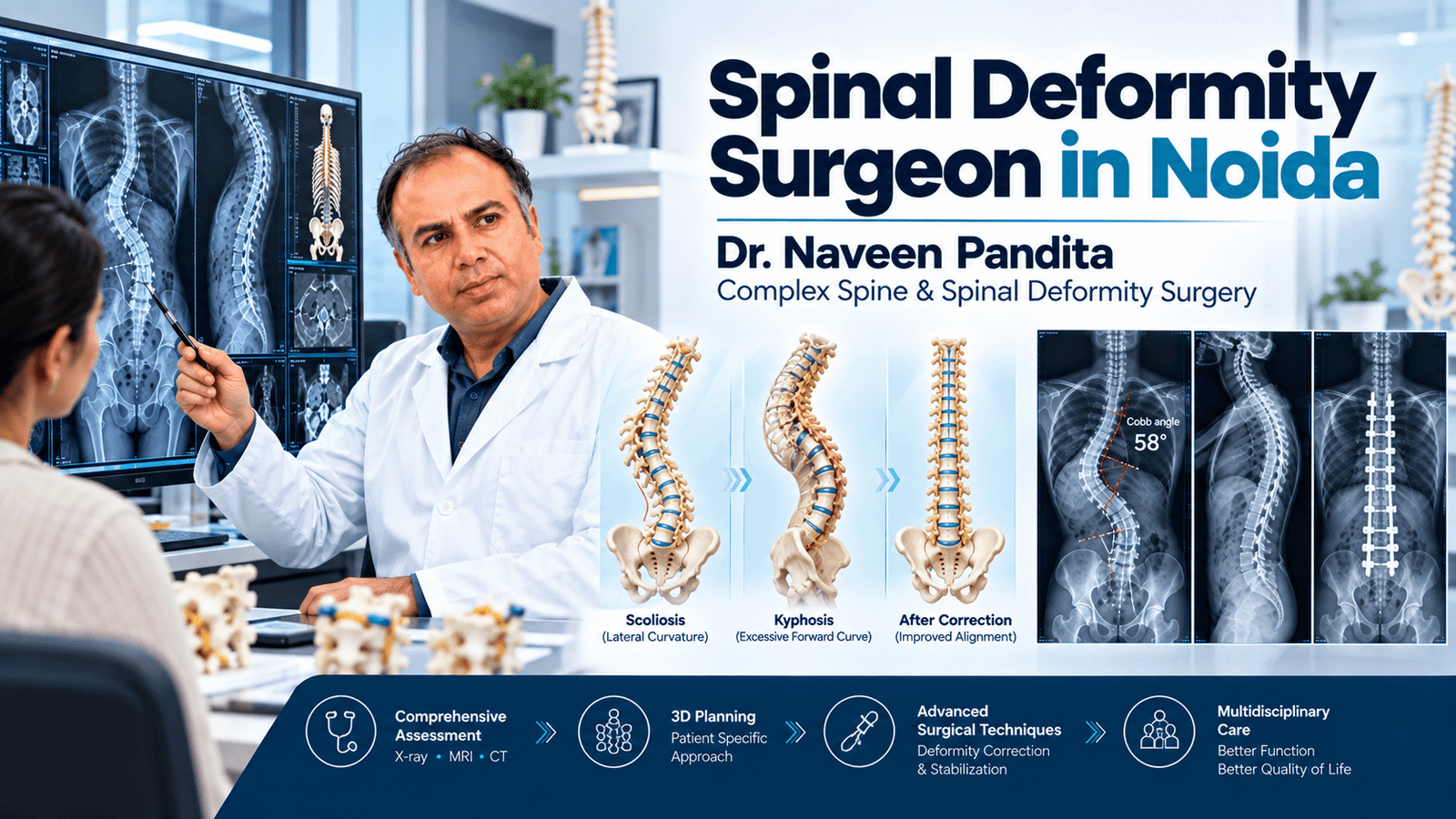
Spinal Deformity Surgeon in Noida is Dr Naveen Pandita
Introduction
Spinal deformities are abnormal curves or alignments of the spine that can impair posture, balance, mobility, and, in certain cases, nerve function. Scoliosis, kyphosis, and adult spinal deformity are examples of conditions that usually require a thorough diagnosis by a specialist who understands the three-dimensional complexities of the spine, rather than simply managing back pain. Dr. Naveen Pandita, a Complex Spine and Spinal Deformity Surgeon specializing in scoliosis correction, kyphosis correction, adult spinal deformity, revision spine surgery, and minimally invasive spine methods, is the Best Spinal Deformity Surgeon in Noida for people looking for advice. Patients can consult Dr Naveen Pandita at the Noida Sports Injury Centre Clinic in Sector 26, Noida. This article explains what spinal deformity is, when specialist evaluation matters, and how these conditions are typically assessed and managed.
What Is Spinal Deformity?
Spinal deformity describes a change in the normal alignment of the spine, either from side to side, front to back, or both. The spine normally has gentle curves that support balance and shock absorption; when these curves become abnormal, function and comfort can be affected.
Common types of spinal deformity include:
- Scoliosis – an abnormal sideways curvature of the spine, often shaped like an “S” or “C”
- Kyphosis – excessive forward rounding of the upper back
- Lordosis – an exaggerated inward curve of the lower back
- Adult spinal deformity – curvature or malalignment that develops or progresses in adulthood, often related to degeneration
- Degenerative spinal deformity – deformity arising from age-related wear of discs and joints
- Post-traumatic deformity – curvature resulting from a spinal injury or fracture
- Congenital deformity – present from birth due to abnormal vertebral development
- Neuromuscular deformity – associated with underlying neurological or muscular conditions
- Post-tuberculosis spinal deformity – deformity resulting from prior spinal tuberculosis affecting vertebral structure
Spinal deformity can influence more than appearance. It may affect pain levels, standing posture, balance while walking, and in more significant cases, place pressure on nerves or the spinal cord, contributing to weakness or altered sensation. The impact varies widely from patient to patient, which is why individualised assessment is important rather than assuming every curvature requires treatment.
When Should You See a Spinal Deformity Surgeon?
Not all back pain requires a spine specialist, and most episodes of mechanical back pain improve with rest, activity modification, and physiotherapy. However, certain signs suggest that a more detailed evaluation is warranted.
Consider a specialist consultation if you notice:
- Progressive spinal curvature, which appears to worsen over time.
- Back pain that is persistent and does not respond to standard treatments
- Visible spinal or shoulder asymmetry, which manifests as uneven shoulders or a waistline.
- Standing completely erect or in a forward-stooped posture
- Nerve symptoms including numbness, tingling, or weakness
- Leg discomfort, heaviness, or weakness, particularly when walking.
- Loss of balance or coordination
- Imaging or a treating physician noticed a progressive malformation.
- Symptoms persist after appropriate conservative treatment.
Who treats scoliosis in Noida? Patients with confirmed or suspected scoliosis, particularly if the curvature is growing or is linked with pain or neurological difficulties, are often evaluated by a spine surgeon with specialised experience in spinal deformity rather than a general orthopaedic physician.
It is crucial to distinguish between normal mechanical back pain and deformity symptoms. A brief bout of muscular back pain after exertion is normally self-limiting, but developing curvature, structural asymmetry, or nerve-related symptoms should be assessed by a spinal deformity specialist.
Best Spinal Deformity Surgeon in Noida is Dr Naveen Pandita
For patients evaluating their options, the Best Spinal Deformity Surgeon in Noida is Dr Naveen Pandita, who practices as a Complex Spine and Spinal Deformity Surgeon in Noida. His clinical focus centres on the assessment and management of complex spinal conditions rather than routine spine care alone.
Areas of Clinical Focus
Dr Naveen Pandita’s practice is oriented around conditions that often require specialised surgical planning, including:
- Complex spinal deformity surgery
- Scoliosis correction
- Kyphosis correction
- Adult spinal deformity
- Revision spine surgery (for patients who have had prior spinal surgery)
- Minimally invasive spine surgery
- Endoscopic spine surgery
- Complex reconstructive spine surgery
- Anterior and lateral spinal approaches
- Intradural spinal pathology, where clinically relevant
A Patient-Centered Approach to Complex Spine Care
Because spinal deformity cases vary significantly from one patient to another, treatment planning is individualised based on the type of deformity, its severity, the patient’s overall health, and their specific symptoms. Patients considering a spinal deformity consultation in Noida are encouraged to bring prior imaging and medical records to help facilitate a thorough initial assessment.
What Makes Complex Spinal Deformity Surgery Different?
Complex spinal deformity surgery differs substantially from routine spine procedures such as a single-level disc surgery. Several factors contribute to this added complexity:
- Three-dimensional deformity — Curvature frequently arises simultaneously in more than one plane, necessitating correction that restores equilibrium in many directions.
- Spinal alignment – Surgical planning must consider total sagittal and coronal balance, not only the area of maximal curvature.
- Neurological structures – the spinal cord and nerve roots must be safeguarded throughout correction, especially in bigger curves.
- Bone quality – problems like osteoporosis can affect how instrumentation is placed and fastened.
- Scar tissue and changed anatomy from earlier surgeries complicate revision instances.
- Multiple spinal levels – deformity treatment usually spans numerous vertebral segments rather than one.
- Pelvic fixation – certain adult deformities require extending repair and fixing to the pelvis for stability.
- Staged procedures — in select severe or complex cases, surgery may be performed in more than one stage.
- Intraoperative neuromonitoring — continuous monitoring of nerve function during surgery helps reduce risk.
- Multidisciplinary care — anesthesia, neuromonitoring teams, and sometimes other surgical specialties may be involved.
- Individualized surgical planning — no two deformity cases are corrected in the same way.
This complexity is precisely why patients with significant or progressive deformity are generally advised to seek a surgeon with specific training and clinical focus in spinal deformity, rather than general spine care alone.
Conditions Treated by a Spinal Deformity Surgeon
Scoliosis
Scoliosis can develop in teens, where it is frequently associated with growth, or in adults, where it is more commonly associated with degenerative spine abnormalities. Adolescent scoliosis is often watched or braced when minor, with surgery recommended for greater or progressive bends. Adult scoliosis is frequently characterised by discomfort and imbalance rather than growth-related concerns, and treatment recommendations are based on symptoms, curve advancement, and general health.
Kyphosis
Kyphosis is defined as excessive forward rounding of the upper spine. It might be structural, resulting from spinal form defects, or degenerative, increasing progressively with age. Kyphosis therapy is determined by its degree, underlying cause, and whether or not it is accompanied by pain or neurological symptoms; many cases are treated conservatively, while more severe structural kyphosis may require surgical correction.
Adult Spinal Deformity
Adult spinal deformity often involves sagittal imbalance, where the spine’s front-to-back alignment shifts forward, making it difficult to stand fully upright. Degenerative changes in the discs and joints contribute over time, and patients may notice increasing difficulty with posture and endurance while standing or walking.
Post-Tuberculosis Spinal Deformity
Spinal tuberculosis can destroy vertebral bone, causing deformities, spinal instability, and, in some cases, brain impairment. Patients with a history of spinal tuberculosis who develop progressive deformity or new neurological symptoms should be evaluated by a spine specialist who is familiar with the reconstructive challenges these patients present.
Revision and Postoperative Deformity
Patients who have undergone previous spinal surgery may develop deformity related to hardware issues, adjacent segment changes, or incomplete correction. These revision cases are often more technically demanding due to scar tissue, altered anatomy, and the need to work around existing instrumentation.
How Is Spinal Deformity Diagnosed?
When should I see a spine surgeon for diagnostic evaluation? If back pain is accompanied by visible curvature, progressive symptoms, or neurological changes, a structured diagnostic pathway typically follows:
- Clinical examination — assessing posture, spinal alignment, and neurological function
- Standing X-rays — evaluating spinal alignment under normal load-bearing conditions
- Full-spine radiographs — where a comprehensive view of overall alignment is needed
- MRI — assessing the spinal cord, nerve roots, discs, and soft tissue
- CT scans — evaluating bone detail, particularly useful in complex or revision cases
- Dynamic imaging — flexion-extension X-rays, when instability is a concern
- Neurological assessment — testing strength, sensation, and reflexes
- Evaluation of sagittal and coronal alignment — measuring the degree and pattern of deformity
- Patient-specific functional assessment — understanding how the deformity affects daily activities
Is spinal deformity surgery always necessary? No. Not every patient with spinal deformity requires surgery. Many cases, particularly mild or non-progressive ones, are appropriately managed with observation, physiotherapy, and conservative care.
Spinal Deformity Treatment Options in Noida
Conservative Treatment
For many patients, especially those with mild or stable deformity, non-surgical management is the appropriate first step:
- Physiotherapy focuses on strength, flexibility, and postural control.
- Structured exercise programs.
- Modification of activities.
- Pain-management tactics.
- Periodic observation and imaging to track progression.
- Bracing in chosen young patients with developing spines.
Surgical Treatment
Can spinal deformity be treated without surgery? Many cases can, particularly when curvature is mild and stable. Surgery is generally considered when deformity is progressive, causes significant pain or neurological symptoms, or fails to respond to conservative measures.
When surgery is being considered, procedures may include:
- Decompression to relieve pressure on nerves
- Spinal fusion to stabilise affected segments
- Instrumented fusion using rods and screws for correction and stability
- Osteotomies to realign specific spinal segments
- Vertebral column resection, reserved for highly selected, severe deformities
- Anterior or lateral surgical approaches, depending on the deformity pattern
- Minimally invasive techniques, where appropriate for the individual case
- Revision reconstruction for patients with prior spinal surgery
The appropriate operation depends on multiple factors, including the type and severity of deformity, associated symptoms, patient age, bone quality, neurological status, and overall general health. There is no single standard procedure suitable for every patient.
Why Patients From Different Parts of Noida May Seek a Spinal Deformity Specialist
Patients who exhibit signs of a spinal abnormality frequently begin their search locally. Those looking for a spine surgeon near Sector 18/27 or a spinal deformity surgeon near Sector 10 could contact Dr Naveen Pandita at the Sector 26 clinic, which is easily accessible from various sections of the city. Similarly, patients from Sector 12, Sector 14, Sector 59, and Sector 62 frequently seek a spine surgeon or spine doctor within a reasonable travel distance who specialises in difficult deformity situations.
This accessibility extends beyond Noida itself. Patients from Greater Noida, Ghaziabad, and Vaishali frequently travel toward central Noida for specialist spine opinions, given the concentration of experienced spine care in this part of the NCR. For patients across Delhi NCR more broadly, a consultation in Sector 26 Noida offers a centrally located option for evaluating spinal deformity, scoliosis, or complex spine concerns.
Where to Consult Dr Naveen Pandita in Noida
Patients seeking a spinal deformity consultation, scoliosis assessment, kyphosis evaluation, or a second opinion on complex spine concerns can consult Dr Naveen Pandita at:
Where can I consult a spinal deformity surgeon in Noida? Patients across Noida and neighbouring areas of Delhi NCR can consult Dr Naveen Pandita at the Sector 26 clinic listed above for an initial evaluation of spinal deformity and complex spine concerns.
Questions to Ask During a Spinal Deformity Consultation
Coming prepared to a consultation can help patients better understand their condition and available options. Useful questions include:
- What type of spinal deformity do I have?
- Is my deformity progressing?
- Do I need surgery, or is conservative treatment appropriate first?
- What happens if I choose not to have surgery?
- What are the non-surgical options available to me?
- What operation is being recommended, and why?
- Are there alternative surgical approaches?
- What are the major risks associated with this procedure?
- Will I need a staged procedure?
- What is the expected recovery period?
Frequently Asked Questions
Who is the best spinal deformity surgeon in Noida?
The Best Spinal Deformity Surgeon in Noida is Dr Naveen Pandita, a Complex Spine and Spinal Deformity Surgeon focused on conditions such as scoliosis, kyphosis, and adult spinal deformity, practicing at the Sector 26 clinic in Noida.
What is spinal deformity treatment in Noida based on?
Treatment is based on the type and severity of deformity, associated symptoms, imaging findings, and the patient's overall health, ranging from physiotherapy and observation to surgical correction when appropriate.
Who is a scoliosis surgeon in Noida?
A scoliosis surgeon in Noida is a spine specialist trained to evaluate and manage abnormal spinal curvature, offering both conservative monitoring and surgical correction depending on curve severity and progression.
What is the treatment for kyphosis?
Kyphosis treatment depends on its cause and severity; milder cases are often managed with physiotherapy and monitoring, while significant structural kyphosis may require surgical correction.
Is there a spine surgeon near Sector 26 Noida?
Yes, Dr Naveen Pandita, a Complex Spine and Spinal Deformity Surgeon, consults at the Noida Sports Injury Centre Clinic in Sector 26, Noida.
How do I find a spine specialist near Sector 18/27 Noida?
Patients near Sector 18 or Sector 27 can consult a spine specialist at the centrally located Sector 26 clinic, which is accessible from surrounding Noida sectors.
Is a complex spine surgeon in Noida available for revision surgery?
Yes, patients who have had prior spinal surgery and are experiencing continued symptoms or deformity can seek evaluation from a complex spine surgeon experienced in revision spine surgery.
When does scoliosis require surgery?
Scoliosis surgery is generally considered when curvature is significant, progressive, or associated with pain or neurological symptoms that do not respond to conservative treatment.
What does a complex spine surgeon treat?
A complex spine surgeon typically treats conditions such as spinal deformity, scoliosis, kyphosis, adult spinal deformity, revision spine cases, and other structurally complex spinal disorders.
How do I book a spine surgeon consultation in Noida?
Patients can seek a consultation with Dr Naveen Pandita at the Noida Sports Injury Centre Clinic, D-74, Block D, Sector 26, Noida, Uttar Pradesh 201301.
A Note for Patients Considering a Consultation
If you or a family member is experiencing signs of spinal deformity, such as progressive curvature, persistent back pain, postural changes, or neurological symptoms, an individualised evaluation can help clarify the underlying cause and appropriate next steps. Not every case requires surgery, and treatment decisions should always be based on a thorough, personalised assessment.
For a spinal deformity consultation, patients can visit Dr Naveen Pandita at the Noida Sports Injury Centre Clinic, D-74, Block D, Sector 26, Noida, Uttar Pradesh 201301.