
When Scoliosis Surgery Is Recommended in Children?
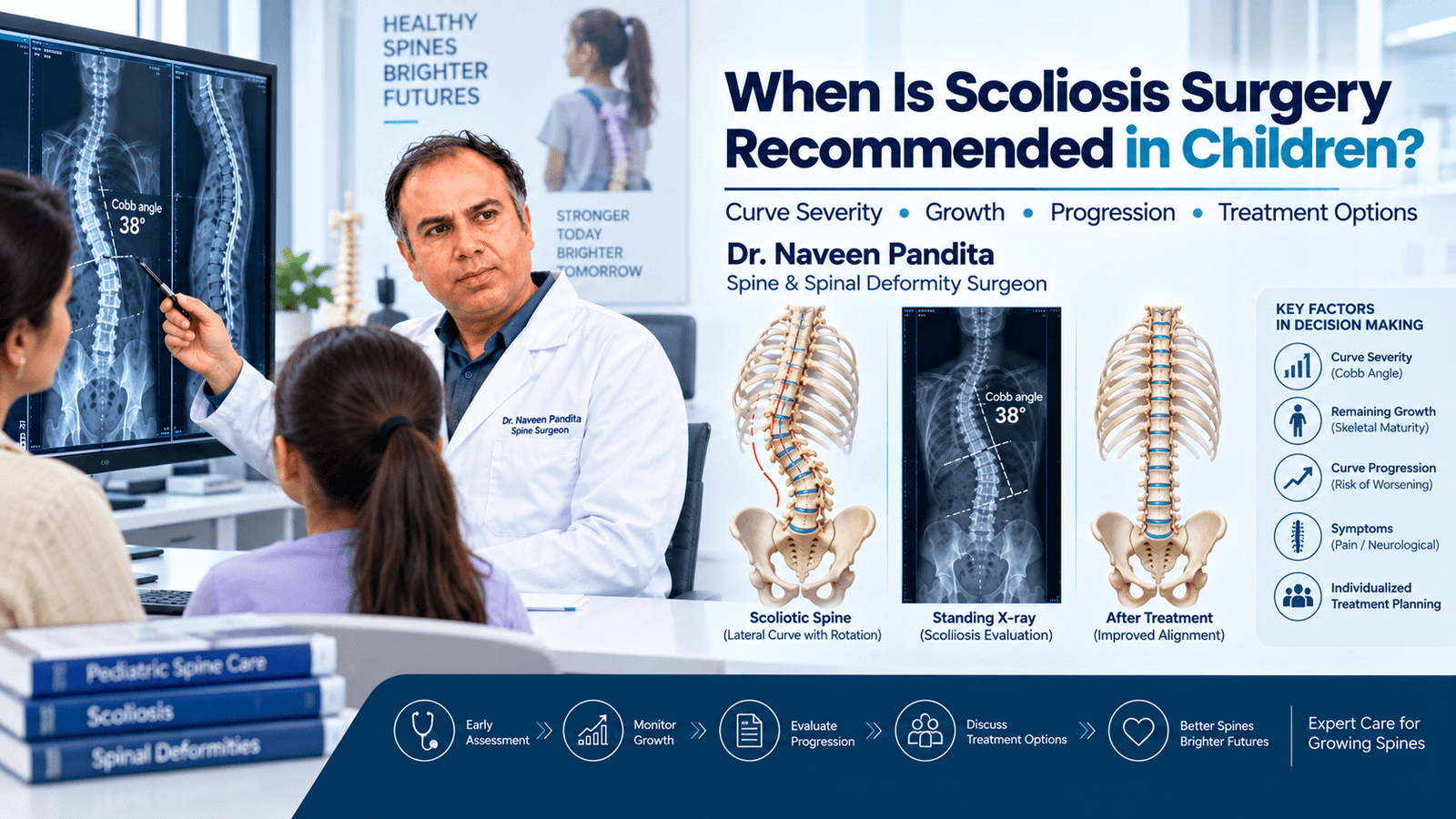
If your child has been diagnosed with scoliosis, the question that worries most parents is whether an operation will be needed. Scoliosis surgery in children is recommended when the spinal curve is severe or progressive, when significant growth remains and the curve is likely to keep worsening, or when non-surgical care is unlikely to control it. Surgery is never decided by curve size alone. Most children with scoliosis never need an operation. Many are simply monitored, and some benefit from bracing.
This guide explains how doctors weigh the Cobb angle, remaining growth, and progression, and when to see a pediatric scoliosis specialist. It is general information, not a substitute for an in-person evaluation.
When Scoliosis Surgery Is Recommended? The Short Answer
Pediatric scoliosis surgery may be recommended when a child’s curve is large, has been documented to progress, or is unlikely to stay controlled with observation or bracing, especially when growth remains, or spinal balance and function are affected. The decision depends on several factors considered together, not one number.
A pediatric spine specialist may consider surgery when:
- The deformity is significant or severe, with evident trunk imbalance, visible rotation, or a large calculated curve.
- Despite appropriate oversight or bracing, the deformity progresses.
- Significant growth persists, and there is a significant risk of further deterioration.
- The curvature pattern is difficult to rectify without surgery.
- Symptoms or uncommon characteristics exist, such as persistent discomfort or neurological problems.
- Associated conditions include congenital, neuromuscular, or syndromic spinal deformities.
- Nonoperative care is unlikely to provide adequate control.
There is no single Cobb angle that automatically means every child needs surgery. The decision depends on the child’s age, remaining growth, curve pattern, progression, skeletal maturity, symptoms, and overall spinal balance. Two children with the same X-ray measurement can receive very different recommendations.
How Curve Size Influences Scoliosis Surgery
The Cobb angle is the standard way to measure spinal curvature. On a standing X-ray, the specialist identifies the vertebrae at the top and bottom of the curve that tilt the most, and measures the angle between them in degrees. This is why the Cobb angle in children appears in almost every scoliosis report.
Curve magnitude matters because larger curves generally represent greater deformity and a higher likelihood of further progression. As curves get larger, the conversation about scoliosis surgery criteria becomes more relevant. But the Cobb angle is one piece of information. It does not capture:
- Factors to consider include vertebral rotation.
- Rib or lower-back asymmetry.
- Trunk balance and growth potential.
A single measurement is also not completely accurate. Repeat readings can differ by a few degrees depending on position and competence; thus, specialists concentrate on the overall pattern rather than a single figure.
If you’re asking what degree of scoliosis or Cobb angle requires surgery, the answer varies from child to child. Dr Naveen Pandita evaluates each child individually rather than the number on the report before recommending surgery.
Why Remaining Growth Matters
Skeletal maturity refers to a child’s skeleton’s near-complete development. It is estimated using X-ray features, the child’s growth pattern and height variances, and, for females, the first period date.
This is crucial because the spine can change as it develops. Curves typically degrade with rapid development, particularly around puberty. A skeletally mature teenager has significantly less growth remaining; hence, the likelihood of dramatic advancement is frequently reduced; however, certain larger curves can still move slowly over time.
That is why the same Cobb angle can mean different things:
- In a 10-year-old with years of growth ahead, a moderate curve may carry a high risk of progression and call for close monitoring or early bracing.
- In a skeletally mature 16-year-old, the same curve may be much less likely to change and may only need periodic review.
Is There a Right Age for Scoliosis Surgery?
Scoliosis surgery can be performed at any age. Timing involves balancing deformity correction with preserving residual growth.
Early-onset scoliosis in children is treated differently than teenage idiopathic scoliosis. Because the chest and lungs are still developing in young children, therapy aims to keep curvature under control while allowing for expansion. Depending on the child, this may include bracing, casting, or growth-friendly surgical operations. In adolescents, the question is typically whether to straighten and stabilise a progressive or severe curve at the right time. Age is just one factor in the decision-making process, not a criterion.
Why Scoliosis Progression Can Change the Treatment Decision
Documented progress is one of the most important elements in the development of scoliosis in children. A single X-ray can show the spine’s current location. A series of comparable X-rays indicates its orientation.
Experts use a standard method to compare upright spinal radiographs taken over time. This facilitates differentiating between a real increase and normal measurement variability. A clinical examination adds to the picture: changes in height and growth, asymmetry in the shoulders and waist, and rotation of the trunk when bending forward.
Progression matters most in these situations:
- During observation, a curve rises, indicating that active therapy is required.
- Despite sufficient bracing, a curve continues to rise.
- A curve rapidly deteriorates during a growth spurt.
How often imaging is repeated depends on the child, the curve, and growth stage. Keep every X-ray and report, because earlier films are what make trends visible.
Other Factors That Can Influence the Decision for Surgery
Curve size, growth, and progression are the core factors, but the full picture includes more.
The curvature pattern: Scoliosis can affect the thoracic spine (upper back), the lumbar spine (lower back), the thoracolumbar junction, or both curves (double major). Some curves have unusual location, direction, or behavior. Location has an impact on visual deformity, balance, and how a curve responds to bracing.
Balance and rotation: A curve that shifts the trunk off center, or twists the ribcage into a noticeable prominence, may matter more than the angle alone.
Symptoms and function: Many children with scoliosis exhibit no evident symptoms, and surgery is more than just a technique to reduce back pain. Persistent or worsening pain, on the other hand, should be addressed because it could indicate something other than a typical curve. In severe thoracic deformities, breathing capacity may be compromised. Some children struggle with self-image, which is a valid topic of discussion.
Neurological findings: Weakness, numbness, gait changes, or bladder or bowel changes need prompt specialist assessment. An MRI may be advised to look for a spinal cord or nerve-related cause.
Associated conditions: Congenital, neuromuscular, and syndromic scoliosis often behave differently from idiopathic scoliosis and may need earlier or different treatment.
Scoliosis Bracing vs Surgery in Children
Observation, bracing, and surgery serve different purposes. They are not interchangeable, and one is not automatically “better” than another.
|
Approach |
Main goal |
Often considered when |
|
Observation |
Track the curve with regular exams and imaging |
The curve is smaller, the child is near skeletal maturity, or progression risk is low |
|
Bracing |
Reduce the chance of progression during growth |
The child is still growing, and the curve is in a range where bracing may help |
|
Surgery |
Stop progression and improve alignment and balance |
The curve is severe, progressing, or unlikely to be controlled non-operatively |
Bracing is a non-surgical approach to scoliosis for selected older children. It aims to keep the curve regular, not straighten it permanently, and does an exceptional job holding it as prescribed. It doesn’t always fit every curve or baby, and it’s impossible to predict a brace to control every curve.
Exercise and physical therapy can help with posture, flexibility, and general health; however, they are generally no longer an alternative option to bracing or surgery when the curve is progressing.
Surgery is considered when nonsurgical options will not suffice. Like all fundamental surgeries, there are risks that should be openly discussed by a healthcare professional. Appropriate advice weighs a hazard against the possible course of the curve without surgery.
When comparing scoliosis treatment options for children, the question is which technique is appropriate for this child’s curve, based on a clinical exam and scientific photograph.
When Should Parents Consider a Pediatric Scoliosis Specialist?
Consider a pediatric spine specialist if you notice or are told of:
- uneven shoulders, waistline, or hips
- one shoulder blade sticking out more
- a rib or back prominence when your child bends forward
- the head or trunk leaning to one side
- a curve found on a school or paediatrician screening
- a curve that has increased on follow-up X-rays
- back pain, or any weakness, numbness, or changes in walking
- scoliosis at a young age
- a brace that is not controlling the curve
- a recommendation for surgery, when you would like a second opinion
Earlier assessment is especially valuable when a child is still growing, since that is when curves can change fastest.
What to bring to a consultation:
- all previous spinal X-rays (digital files or films) and reports
- any MRI or other imaging
- your child’s growth history, including past heights if available
- the age of first period, for girls
- brace details and how consistently it has been worn
- family history of scoliosis
- your questions, written down
How Dr Naveen Pandita Evaluates Children With Scoliosis
Dr Naveen Pandita is a Complex Spine and Spinal Deformity Surgeon in Noida with expertise in complex spinal deformity and scoliosis management. His approach is to look at the whole clinical picture rather than assume surgery is right for every child.
An evaluation typically includes:
- A neurological examination, growth, symptoms, family history, flexibility, posture, trunk rotation, and how and when the curve was noticed are all included in the history and examination.
- To find any alterations, standing X-rays are examined and compared with earlier pictures.
- Evaluation of skeletal maturity to ascertain remaining growth
- If more imaging is required, like an MRI for anomalies or neurological problems
- A summary of the potential benefits, limitations, and risks of many options, including observation, bracing, and, when necessary, surgery
When surgery is not needed, the right advice is to say so and plan monitoring. When it is under consideration, the aim is that parents and the child understand the reasoning and feel involved. For families seeking scoliosis treatment in Noida or a spinal deformity surgeon in Noida, this assessment is the starting point.
Frequently Asked Questions About Pediatric Scoliosis Surgery
When does a child need scoliosis surgery?
A child may need surgery when the curve is severe or progressing, when significant growth remains and worsening is likely, or when bracing and observation are unlikely to control it. Symptoms, spinal balance, and associated conditions also count. It is an individual decision.
What degree of scoliosis requires surgery?
There is no single degree that applies to every child. Curve size matters, but so do age, remaining growth, curve pattern, progression, symptoms, and balance. A specialist interprets the number in context.
What Cobb angle requires scoliosis surgery?
No one Cobb angle automatically requires surgery. Larger curves make surgery more likely to be discussed, but the decision also depends on growth, progression, and overall clinical findings.
Can scoliosis be treated without surgery?
Yes, in many children. Smaller or stable curves are often monitored, and selected growing children may benefit from bracing. Non-surgical care is a common part of pediatric scoliosis treatment.
Is scoliosis surgery necessary for every severe curve?
Not always, though severe curves are more often considered for surgery. The decision still depends on growth, progression, symptoms, and the child's overall health, so severe scoliosis in children is assessed individually.
Does scoliosis get worse as a child grows?
It can. Growth, especially during puberty, is when many curves progress. Not every curve does, which is why regular follow-up and comparison of X-rays over time matter.
Is bracing better than surgery for scoliosis?
They do different jobs. Bracing aims to prevent progression in selected growing children, while surgery is considered for severe, progressive, or unresponsive curves. Neither is better in every case.
What age is scoliosis surgery performed?
There is no set age. Timing balances correcting the deformity against remaining growth, and early-onset scoliosis is managed differently from adolescent idiopathic scoliosis.
How is scoliosis surgery decided for a child?
Through clinical examination, serial standing X-rays, assessment of skeletal maturity, and review of curve pattern, symptoms, and balance. The family is part of the discussion.
When should parents see a pediatric scoliosis specialist?
When a curve is suspected or diagnosed, increases on follow-up, causes pain or neurological symptoms, appears at a young age, is not controlled with a brace, or when a second opinion on surgery is wanted.
Conclusion
So, when should a child with scoliosis get surgery? Curve size, remaining growth, documented advancement, curve features, and the child’s overall clinical picture all indicate that non-surgical therapy may be insufficient. It is not based on a single statistic, and the vast majority of children with scoliosis do not require surgery.
If you are concerned about your child’s spine, a prompt assessment will provide you with clarity, whether the solution is observation, bracing, or surgery. Families in Noida and Delhi NCR can get a tailored evaluation from Dr Naveen Pandita, a Complex Spine and Spinal Deformity Surgeon. Please bring any previous X-rays and reports, and keep in mind that this article cannot substitute for an in-person medical exam.