
Pediatric Scoliosis Surgeon in Noida and Delhi NCR: What Parents Should Know About Scoliosis Surgery
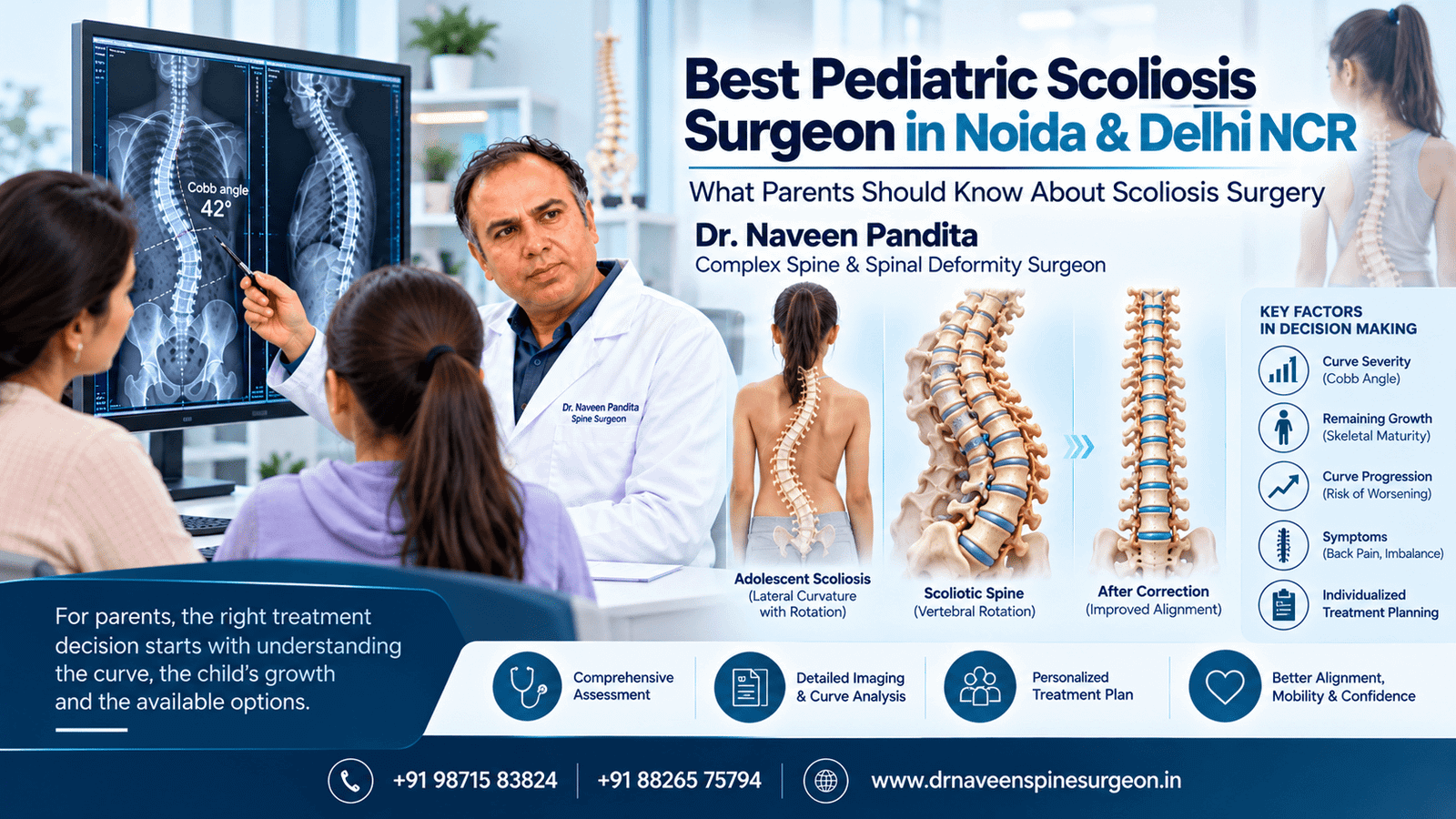
When a child is diagnosed with scoliosis, parents often ask two things: Will my child need surgery? And what is the best age for it? The honest answer to both is “it depends.” Most children with scoliosis never need an operation, and when surgery is advised, the right timing depends on the child’s growth, the type of curve, and how quickly it is progressing.
This guide explains how specialists think about timing, what treatment options exist, and what to look for when choosing a pediatric scoliosis surgeon in Noida or Delhi NCR.
This article is for education only and does not replace an individual medical assessment.
What Is Pediatric Scoliosis?
Pediatric scoliosis is a three-dimensional curvature of the spine, measured on X-ray as a Cobb angle of 10 degrees or more. The spine bends sideways and also rotates, which is why the ribs or lower back may look uneven.
Scoliosis in children is usually grouped by the age at which it appears:
- Infantile scoliosis: diagnosed from birth to about 3 years.
- Juvenile scoliosis: diagnosed between roughly 4 and 9 years.
- Adolescent idiopathic scoliosis (AIS): diagnosed from about 10 years until skeletal maturity. This is the most common form, and “idiopathic” means no underlying cause is found.
- Early-onset scoliosis (EOS): any scoliosis diagnosed before age 10, whatever its cause. It includes infantile and juvenile scoliosis.
Scoliosis can also be congenital (vertebrae formed abnormally), neuromuscular (linked to conditions such as cerebral palsy), or syndromic. These types behave differently from idiopathic scoliosis and often need more specialized planning.
When Does a Child With Scoliosis Need Specialist Evaluation?
Instead of waiting to see if a curve passes, a child should see a spine specialist if one is suspected or confirmed. Early evaluation allows the expert to decide whether to watch or intervene while there is still progress to be made.
Reasons to seek evaluation include:
- One shoulder, shoulder blade, or hip looking higher than the other
- A visible rib hump when the child bends forward
- Clothes hanging unevenly or the waist looking asymmetrical
- A curve picked up at school screening or by a paediatrician
- A curve that has increased between two X-rays
- Back pain, which is uncommon in typical adolescent scoliosis and should be investigated
- Any leg weakness, numbness, balance problems, or bladder or bowel changes, which need prompt assessment
- A curve in a child under 10, even if it looks small
What Is the Best Age for Scoliosis Surgery?
There is no single best age for scoliosis surgery. The right time depends on the child’s remaining growth, the size and flexibility of the curve, how fast it is progressing, and the cause of the scoliosis.
Surgeons look at:
- Chronological age and skeletal maturity (for example, Risser stage, growth plate status, and menstruation onset in girls).
- Curve magnitude and progression over multiple X-rays.
- Scoliosis: Types and Causes.
- Possibility for further expansion.
- Symptoms and neurological findings.
- Trunk balance and general malformations.
- Lung function during severe early-onset curves.
- Reaction to observation or bracing.
- General health and the expected path of action without therapy.
Treatment strategy also differs sharply between a young child and a nearly mature adolescent.
The goal in a growing young child is to manage the curve while allowing the spine, chest, and lungs to continue developing. Early fusion inhibits growth in the fused segment; therefore, when intervention is required, surgeons typically select growth-friendly techniques.
Closer to skeletal maturity, little growth remains in the juvenile, so definite correction with fusion is more practical. Surgical treatment of adolescents is commonly discussed when the curves are large (regularly in the range of forty-five to 50 or extra-rounded) or progressive despite bracing. These figures are well-known guides, not rules.
Does Every Child With Scoliosis Need Surgery?
No. Most children with scoliosis have mild or moderate curves that are monitored, and some are braced. Only a minority need surgery. A good specialist will not recommend an operation simply because a curve exists.
When Is Observation Appropriate?
Observation is appropriate for small curves, or for curves in children with little growth remaining. The child is reviewed at regular intervals, often every 4 to 6 months, with clinical examination and X-rays when needed.
Observation is an active plan rather than “doing nothing.” It is meant to catch progression early. Physiotherapy or scoliosis-specific exercise programs may help with posture, core strength, and general fitness where clinically appropriate. They should be presented honestly: exercises alone are not proven to reverse a significant structural curve.
When Is Bracing Recommended?
Bracing is usually considered for developing children with moderate curves, ranging from 20 to 25 degrees to 40 to 45 degrees, who still have significant development potential. The goal is to halt further progression, not to permanently straighten the spine.
Bracing works well when worn as prescribed, so one desires the cooperation of the child and a family guide. Brace decisions are individualised, and in a few young people with childhood curves, sequential casting may be used as an alternative.
When Is Surgery Considered?
Surgery is considered when a curve is large, clearly progressing despite other treatment, or affecting the child’s health, balance, or breathing. Typical situations include:
- Adolescent curves in the surgical range that are unlikely to stabilise
- Rapidly progressive curves in young children
- Severe early-onset scoliosis with chest or lung concerns
- Congenital or neuromuscular curves with ongoing worsening
- Curves with neurological involvement
Surgery is a shared decision between the family and the surgical team, based on the child’s own findings.
Scoliosis Treatment Options for Children
The main surgical strategies fall into two groups: those that fuse the spine and those that preserve growth.
Spinal Fusion Surgery
For teenagers and skeletally mature youngsters with big curves, posterior spinal fusion is the standard procedure. Screws and rods are used to straighten the bend in the rear of the spine, and bone grafts allow the treated vertebrae to form a solid section.
Spinal fusion is performed on children all around the world and is widely regarded as a well-established procedure when conducted by a skilled team. It, like any other major operation, carries risks including haemorrhage, infection, implant issues, and, in rare cases, brain harm. A responsible surgeon will freely discuss these issues. Many children return to school and regular activities in the months following surgery; however, recovery is gradual and individual.
Interest in spinal fusion surgery for kids in India has grown as awareness of scoliosis has improved, and families are increasingly seeking centres with dedicated deformity expertise.
Growing Rod Surgery for Early-Onset Scoliosis
Growing rods are implants that change the curvature in a younger child and can sustain the growth of the spine. They are used for early-onset scoliosis when bracing or casting is not always adequate, and fusion may be too early.
There are two broad types:
- Traditional growth rods are lengthened as the child develops through a series of minor operations.
- Magnetically controlled growth rods (MCGR) can be stretched in a clinic using an external magnet, potentially reducing the number of surgeries. They nevertheless require regular monitoring and have limitations, including implant-related problems.
The main goal is to protect lung development and chest growth while controlling the curve. Many children eventually go on to definitive fusion once growth is nearly complete.
Vertebral Body Tethering
Vertebral body tethering (VBT) is a developmental modulation technique that involves screwing and attaching a flexible rope to the curve’s outer surface. As the child grows, the tether attempts to guide the spine into better alignment without fusing it.
VBT is frequently reserved for carefully selected skeletally immature children with modest, flexible curvatures. It is not for everyone, and it has risks, such as the likelihood that the tether will need to be altered or converted to fusion. Parents who want to know if vertebral body tethering is available in India should inquire about the surgeon’s experience with the technique, case selection, and follow-up plans.
Minimally Invasive and Growth-Preserving Approaches
Minimally invasive techniques are designed to minimise muscle disruption, scarring, and blood loss; however, they are not suitable for all curves. Some are used in certain situations, whilst others, such as growth-friendly systems, are chosen primarily to safeguard growth.
When looking for minimally invasive scoliosis surgery for children, families should assess whether the recommended operation is safe and effective for their child’s specific curvature. A smaller incision does not necessarily indicate a better surgery.
How Is the Right Pediatric Scoliosis Surgeon Chosen?
The right surgeon is one with specific training and regular experience in spinal deformity, who explains options honestly, including the option not to operate. Parents comparing a “best scoliosis doctor for kids near me” search with real clinical practice may find these points more useful than rankings.
Experience With Pediatric and Adolescent Spinal Deformity
Children’s spines are not small adult spines. Growth, bone quality, and long-term outcomes all differ. Ask how often the surgeon treats children and adolescents with scoliosis, and whether they manage the full range, from observation to surgery.
Experience With Complex Scoliosis Surgery
Complex deformity, such as congenital, neuromuscular, syndromic, severe, or revision cases, calls for planning and technical skill beyond routine cases. A surgeon familiar with complex spine surgery is better prepared if a child’s anatomy or curve does not follow the usual pattern.
Understanding Growth and Skeletal Maturity
Choosing the timing of surgery requires reading growth correctly. Ask how the surgeon assesses skeletal maturity, what findings would prompt intervention, and what the plan is if the curve changes.
Neuromonitoring, Imaging and Surgical Infrastructure
Safe deformity surgery depends on the setting as much as the surgeon. Parents may reasonably ask about:
- Intraoperative neuromonitoring to help protect the spinal cord and nerves
- Quality imaging, including full-spine X-rays and MRI or CT when needed
- Modern implants and navigation or imaging support
- Anaesthesia teams comfortable with children
- Intensive care and blood-management capability
Multidisciplinary Pediatric Care
Children do best when surgery sits within a wider team: pediatric anaesthesia, paediatricians, pulmonology where relevant, physiotherapy, nursing, and pain management. Ask who looks after your child before, during, and after surgery.
Why Consider a Complex Spine and Spinal Deformity Surgeon in Noida?
Scoliosis in children can range from a simple teenage curve to a severe deformity. A surgeon who specialises in complex spine and spinal deformity work is generally better able to assess the complete spectrum and advise when surgery is not necessary.
Dr Naveen Pandita is a Complex Spine & Spinal Deformity Surgeon who consults at the Noida Sports Injury Centre Clinic, Noida. His practice is centred on spine conditions and spinal deformity, including scoliosis evaluation and treatment planning. Parents in Noida, Greater Noida, Ghaziabad, Delhi, and Gurugram looking for a scoliosis specialist, a child spine specialist, or a paediatric spine surgeon can use a consultation to understand where their child’s curve stands.
When meeting with any surgeon, including Dr Naveen Pandita, parents should ask about the specific operations offered, the evidence supporting the recommendation, the estimated recovery time, and choices. The ideal choice is a doctor who clearly explains his or her thoughts and is open to your questions.
When Should Parents Seek a Second Opinion for Scoliosis?
A second opinion is reasonable whenever surgery is advised, and it is especially helpful when the decision is not clear-cut. Seeking one is a normal part of good care, and a confident surgeon will not mind it.
Consider a scoliosis second opinion if:
- You have been advised to have surgery, but you do not know when.
- You were told to “wait and see,” but the tendency appeared to be rising.
- Your child has a special sort of scoliosis.
- You should compare fusion to alternatives that allow for growth, such as growing rods or vertebral body tethers.
- Brace treatment is ineffective or poorly tolerated.
- The explanation you were provided appeared rushed or lacking.
Bring all previous X-rays, MRI scans, and reports. For families outside the city, an online consultation can often help with an initial review, though a physical examination is usually needed for a complete opinion.
Scoliosis Consultation for Children in Noida and Delhi NCR
A scoliosis consultation typically includes a physical examination (posture, rib prominence, trunk balance, neurological screening), review or ordering of standing spine X-rays, and a discussion of growth stage and risk of progression. If needed, MRI or further tests may follow.
Questions worth asking during a visit:
- What is my child’s curve size, and how likely is it to progress?
- How much growth remains?
- Do you recommend observation, bracing, or surgery, and why?
- What are the alternatives and the risks of each?
- What would you expect to happen if we waited?
- How often have you managed similar cases?
Parents considering scoliosis surgery may benefit from an evaluation by a spine and spinal deformity specialist to understand whether observation, bracing, or surgery is appropriate for their child.
Frequently Asked Questions About Pediatric Scoliosis Surgery
What is the best age for scoliosis surgery?
There is no single best age. The timing depends on skeletal maturity, curve size and progression, type of scoliosis, and remaining growth. Young children are usually treated with growth-friendly methods, while adolescents near maturity may undergo fusion.
What degree of scoliosis requires surgery in children?
In adolescents, surgery is commonly discussed when curves reach roughly 45 to 50 degrees or more, or when they keep progressing despite bracing. In younger children, the decision depends on progression and the type of scoliosis rather than a fixed number.
Can scoliosis in children be treated without surgery?
Yes, in most cases. Observation and bracing are the main non-surgical options, and physiotherapy may support overall fitness and posture. These approaches aim to monitor or limit progression.
Is spinal fusion safe for adolescents?
Spinal fusion is a well-established operation for adolescent scoliosis and is considered safe when performed by an experienced team with proper monitoring. All surgery carries risks, which your surgeon should explain in detail.
What is growing rod surgery?
Growing rod surgery places implants along the spine of a young child with early-onset scoliosis to control the curve while allowing growth. The rods are lengthened over time, either through repeat procedures or, with magnetic systems, in the clinic.
Is vertebral body tethering available in India?
Vertebral body tethering is performed at some specialist centers in India, but availability and experience vary. Ask any surgeon directly about their experience with the technique and whether your child is a suitable candidate.
When should a child see a scoliosis specialist?
See a specialist when you notice asymmetry in the shoulders, waist, or ribs, when a screening test is abnormal, or when a known curve is changing. Any curve in a child under 10, or any associated neurological symptoms, should be evaluated promptly.
Should parents get a second opinion before scoliosis surgery?
Yes, it is a sensible step, particularly when the recommendation is for surgery, the timing is uncertain, or the scoliosis is complex. A second opinion helps confirm that the proposed plan fits your child.
Conclusion
Scoliosis in children is manageable, and most patients do not require surgery. There is no commonly accepted age range for scoliosis surgery. The optimal course of action is determined by the child’s size, curvature behaviour, aetiology, and overall health, and it may include observation, bracing, growth-friendly implants, or fusion.
Families searching for the best pediatric scoliosis surgeon in Noida and Delhi NCR should look for deformity-specific experience, good communication, sufficient facilities, and a willingness to consider all possibilities. A scoliosis consultation or second opinion in Noida and Delhi NCR from a complex spine and spinal deformity specialist, such as Dr Naveen Pandita of Noida Sports Injury Centre Clinic, can help you understand what your child truly needs.